





The GA Guide / Necklace layering
How to Layer
Necklaces
A little space. A different texture.
Your own way of putting it together.
Learn the lengths, build your first combination and find your next look. Twenty layered combinations and six single-necklace starting points, all ready to explore.
Start with the six steps Shop the necklace looks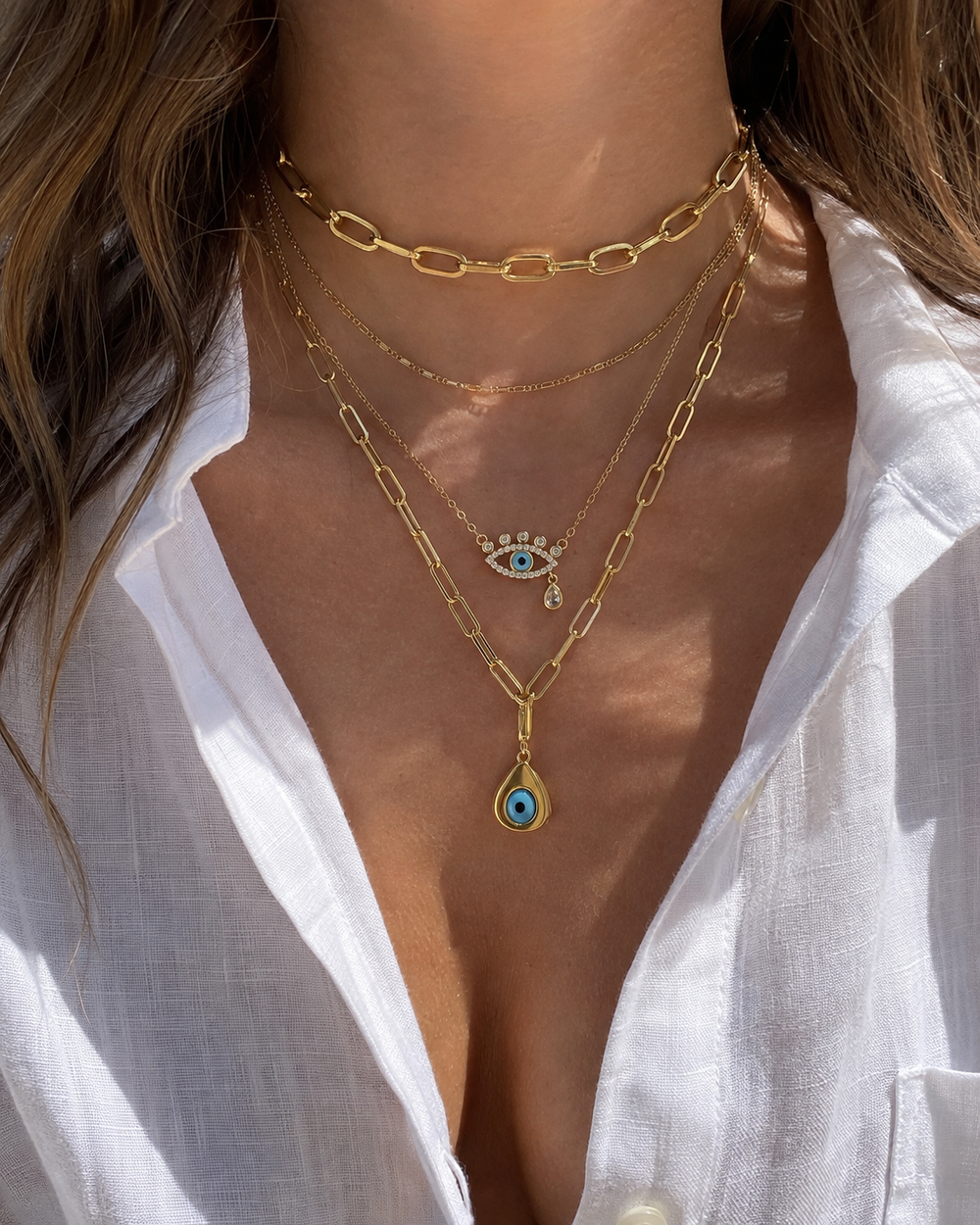
01 / Start here
How do you
layer necklaces?
Start with two or three necklaces at different lengths. Choose one focal piece, vary the chain thickness or texture, and adjust each necklace so its shape stays visible. Put your outfit on first: the neckline helps you decide where the layers should sit.
There is no single perfect number of chains. Two create a clear contrast; three give you a short, middle and longer line. Add more only when you like the balance and the pieces sit comfortably.
-
Choose the neckline.
Try the necklaces over the top you will actually wear. Notice whether the fabric leaves space for a short necklace, catches a pendant or needs a longer line over it.
-
Pick your focal piece.
Choose the necklace you want to notice first: a strong paperclip link, an evil eye, a crystal charm or a small personal pendant. Build the other layers around it.
-
Set the lengths.
Try 35, 40 and 45 cm for closer layers, or 35, 45 and 50 cm for more separation. These are starting points; adjust for your neck and the pendant drop.
-
Change one texture.
Pair a fine chain with a wider link, a smooth shape with small bead stations, or a metal chain with a dark cord. A change in scale makes each layer easier to see.
-
Balance the details.
If one necklace has a cluster of charms, let the other be simpler. If you mix metal finishes, repeat one somewhere else in the look.
-
Check it in motion.
Turn your head, sit down and move your shoulders. Adjust any pendants that overlap or catch the neckline. Remove a layer if the combination feels crowded.
Your first two-necklace combination: try the Cara & Vittoria combination at 35 cm with the emerald-cut Large Link combination at 45 cm. Two chain scales, two crystal shapes and a clear gap.
See this combination02 / Make space
Choose lengths
that work together.
The number on the label describes the chain, not exactly where the pendant will sit on you.
Neck size, neckline, link shape and pendant length all change the result. Measure a necklace you already like, then use our necklace length guide to choose your starting point. A short chain should feel comfortable when you turn your head and sit down.
| Starting lengths | The effect | Try it with |
|---|---|---|
| 35 + 40 cm About 14 + 16 inches |
Two close layers. Best when the chains have different shapes and the pendants stay clear. | The Golden Talisman Layers |
| 35 + 45 cm About 14 + 18 inches |
More room between two statement necklaces. | The Double Vittoria Layers |
| 35 + 50 cm About 14 + 20 inches |
A short upper line and a visibly longer pendant or chain. | The Vittoria Black Rhodium Layer |
| 35 + 40–45 + 50 cm | Three levels with a fine necklace between stronger links. | The Silver Link Layers |
| 40 + 45 cm About 16 + 18 inches |
A small gap using a 5 cm extender on the lower necklace. | Scarlett or Charlotte in silver |
Use the extender before buying another length.
Scarlett, Catalina, Twisted, Box and the silver Charlotte chains linked in this guide measure 40 cm with a 5 cm extender. Fastening one shorter and another longer can create a useful gap. If both pendants still land together, change the base length or remove one.
Our Large Link and Cara chains offer separate length options. To wear the same chain at two lengths, you need two necklaces: an extender does not turn one chain into two layers.
Explore the chains03 / Work with the outfit
A neckline guide
you can use in the mirror.
| Neckline | Build the layers | Check before you leave |
|---|---|---|
| Open shirt or V-neck | Place a shorter chain near the opening, then let a pendant follow the V below it. | Keep the lower charm clear of buttons and the edge of the shirt. |
| Crew-neck T-shirt | Choose a short necklace that clears the collar, or wear the whole combination over the fabric. | A pendant resting exactly on the collar can disappear or catch as you move. |
| Scoop or square neck | Try two or three visible lines within the open space, with one pendant as the focus. | Leave breathing room between the lowest necklace and the fabric. |
| High neck or knitwear | Try a longer chain or adjustable cord over the fabric, then add a second texture. | Check that hooks, clasps and textured links do not snag the knit. |
| Strapless or off-shoulder | Use one strong short line with a lower, smaller detail, or keep two fine chains close together. | Make sure the combination feels balanced when seated as well as standing. |
04 / Copy a little. Make it yours.
Twenty-six looks.
A lot of ways to layer.
Choose a photographed combination, follow its three styling steps, then open “Shop the pieces” for direct product links. The first twenty looks use multiple necklaces; the final six start with one.
On each look page you can check current prices, select lengths and choose the pieces you need. Some products already combine a chain and a charm. Read the item name before adding a separate charm, and check quantities when a chain appears twice.
The Looks / 3 combinations
Two necklaces. A very good start.
Start with two distinct lines before adding more. These combinations show how a small change in length or texture can do most of the styling.
Layer by layer
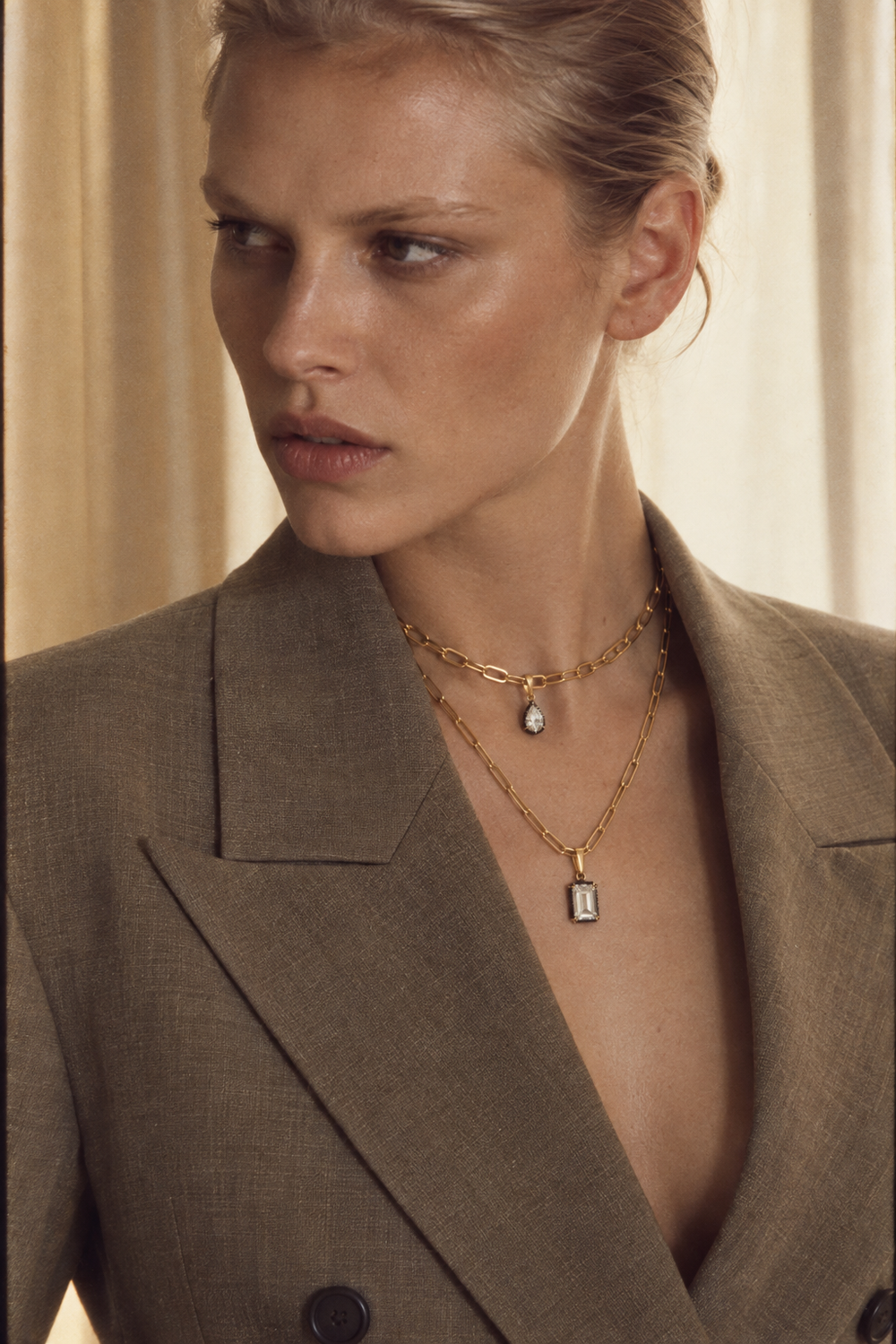
The Double Vittoria Layers
- Choose the Cara combination at 35 cm for the upper line.
- Add the Large Link combination at 45 cm below it.
- Let the two different crystal shapes sit clear of one another.
Shop the pieces in this look
Layer by layer
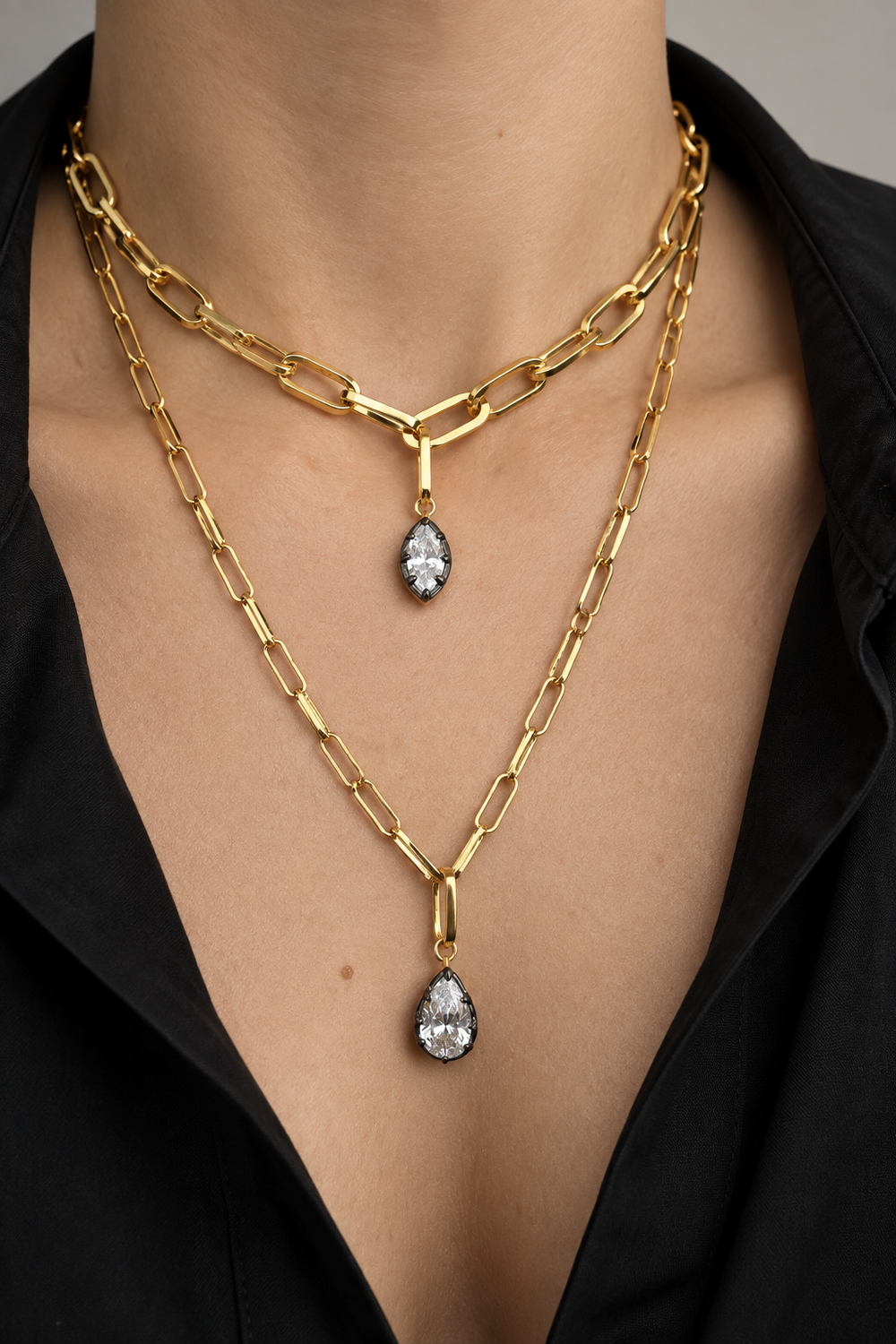
The Vittoria Black Rhodium Layer
- Wear the Cara Marquise combination at 35 cm.
- Take the paperclip and teardrop combination down to 50 cm.
- Keep the neckline open so the space between pendants stays visible.
Shop the pieces in this look
Layer by layer
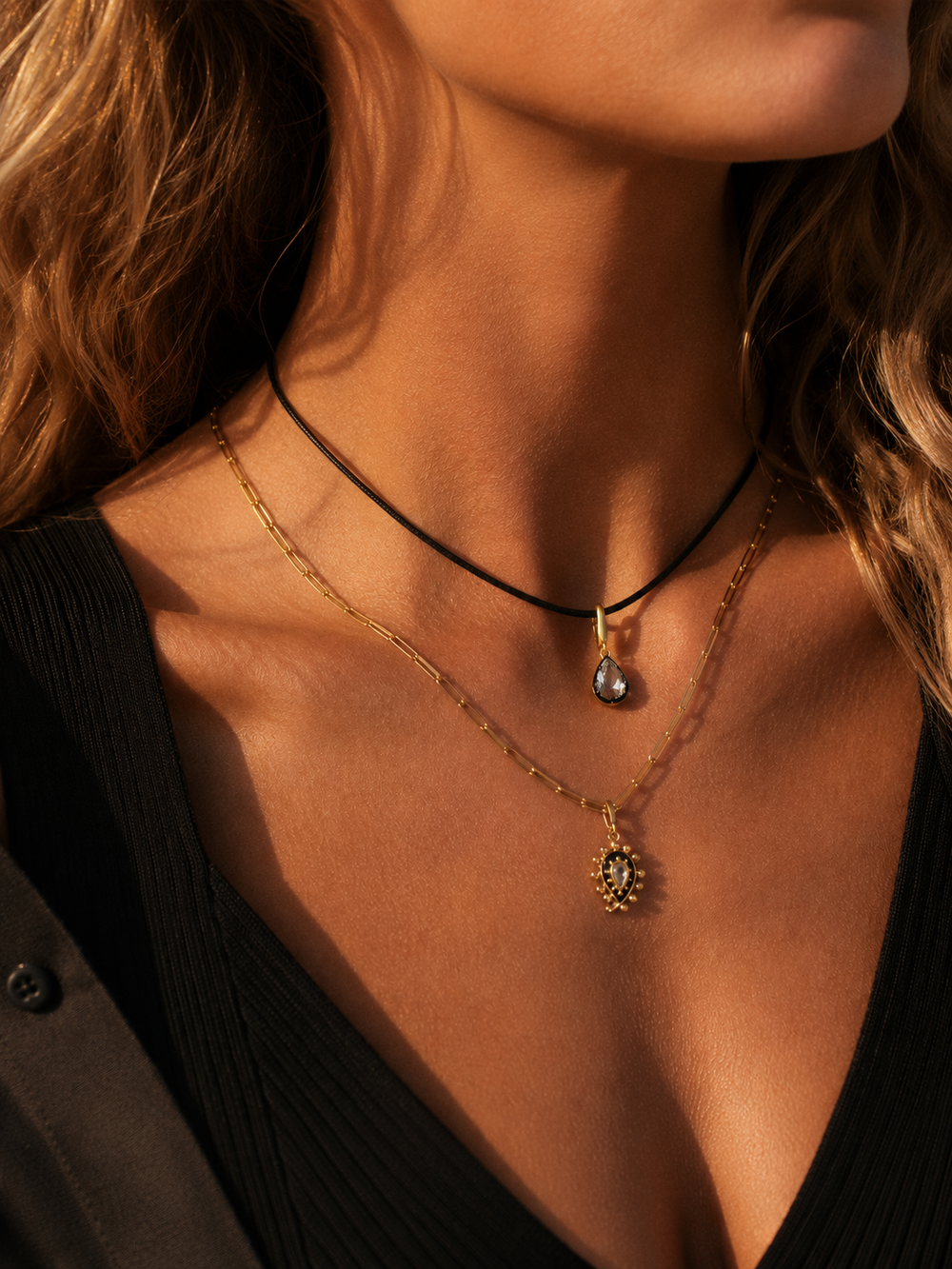
The Paisley Layers
- Set the cord and Vittoria teardrop close to the neckline.
- Place the paperclip and Paisley combination below it.
- Adjust the cord until each charm has its own space.
Shop the pieces in this look
The Looks / 5 combinations
Gold layers, from fine to bold.
Keep the finish consistent and change the chain shape, length or pendant. Gold layers can feel light and simple, or full of detail.
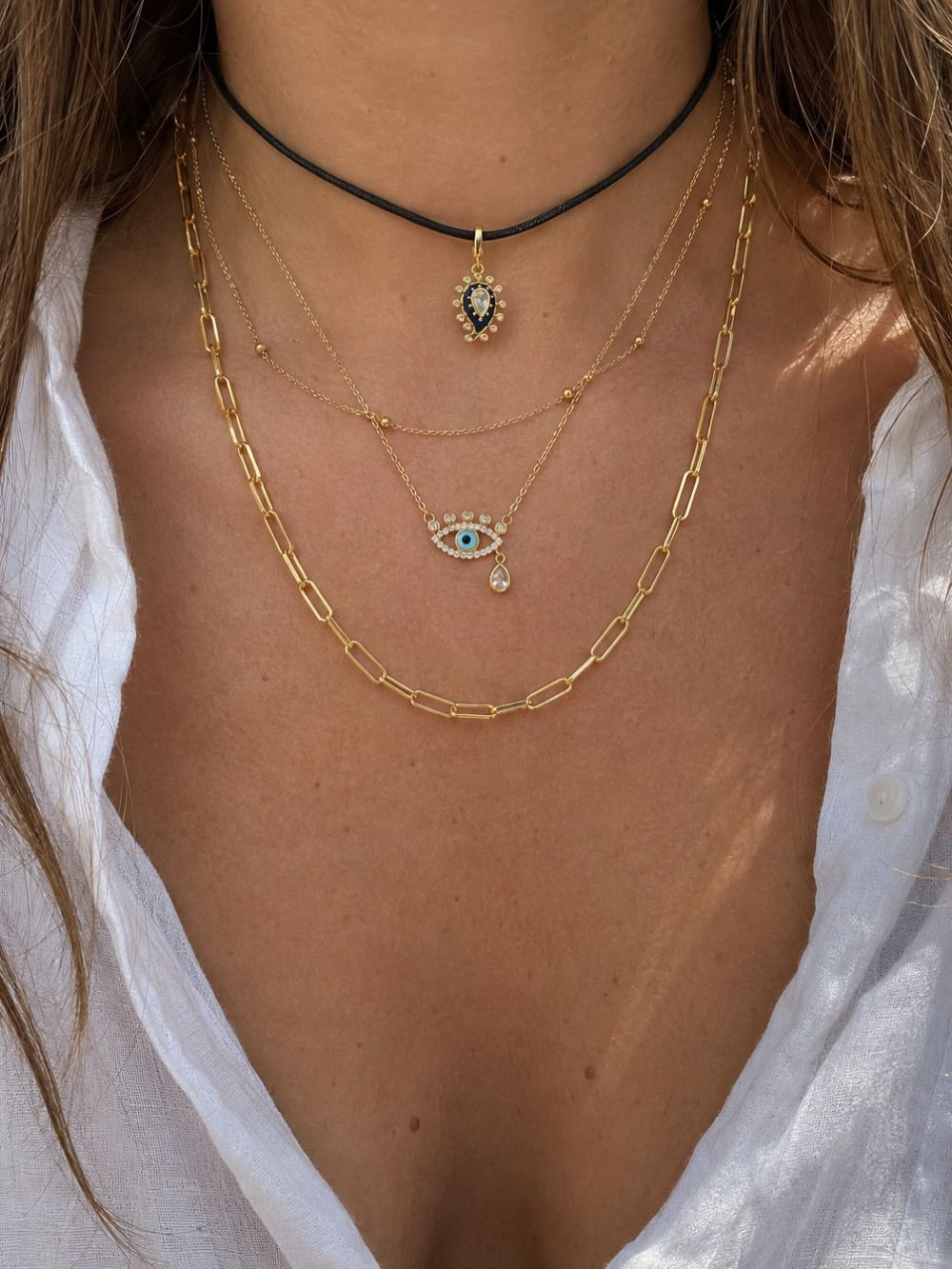
Layer by layer
The Golden Layers Look
- Start with the cord and Paisley charm close to the neck.
- Place the Weeping Evil Eye necklace through the middle.
- Choose the Large Link chain at 45 cm for the longest line.
Shop the pieces in this look
Layer by layer
The Golden Talisman Layers
- Start with the Cara chain at 35 cm.
- Add Scarlett and the Weeping Evil Eye as finer layers.
- Place the paperclip and Triangle Evil Eye combination at 40 cm.
Shop the pieces in this look
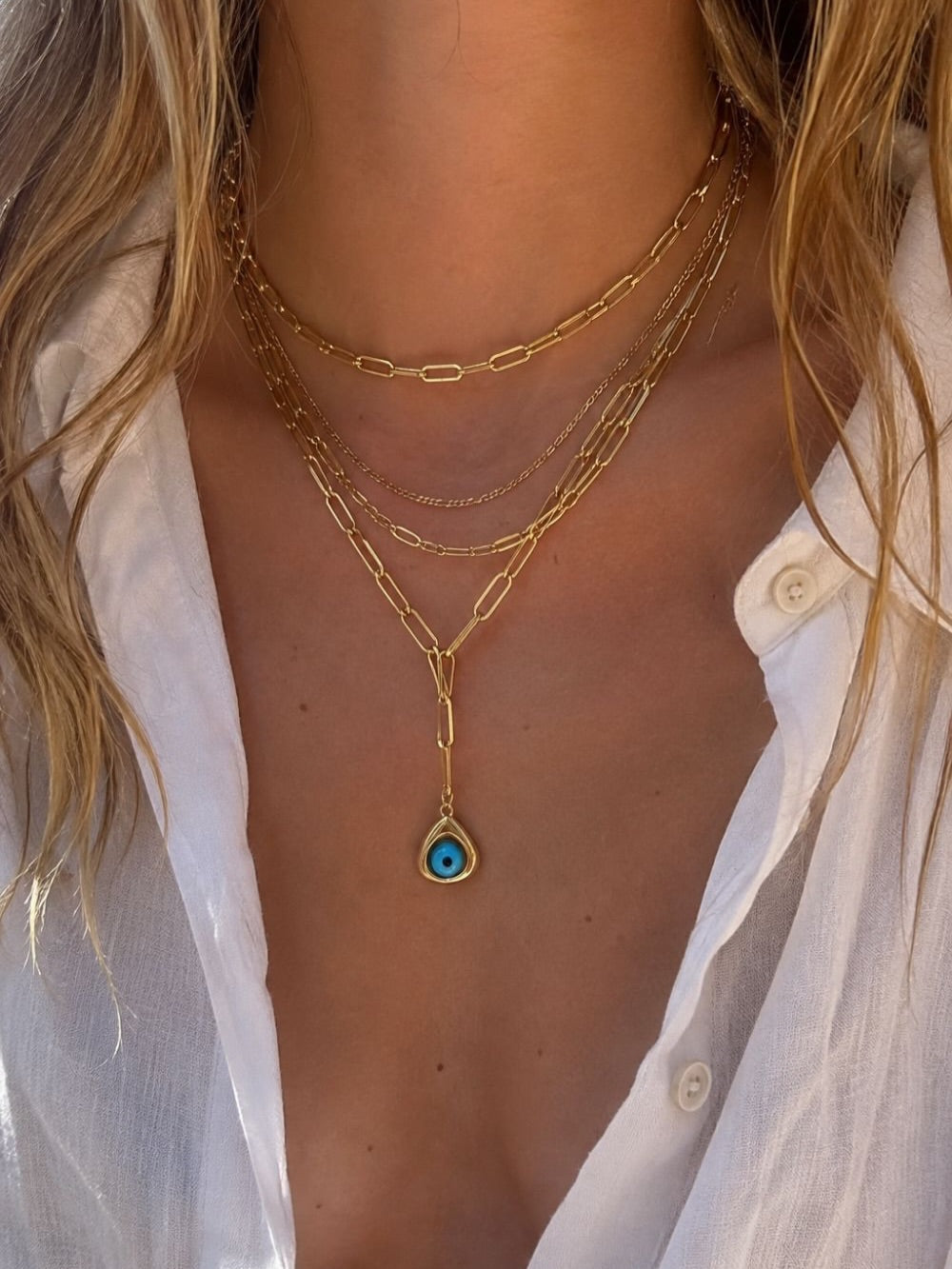
Layer by layer
The Double Link Layers
- Repeat the Large Link chain at 35 cm and 40 cm.
- Use Scarlett and Catalina to bring finer texture between the links.
- Let the Triangle Evil Eye form the pendant focus.
Shop the pieces in this look
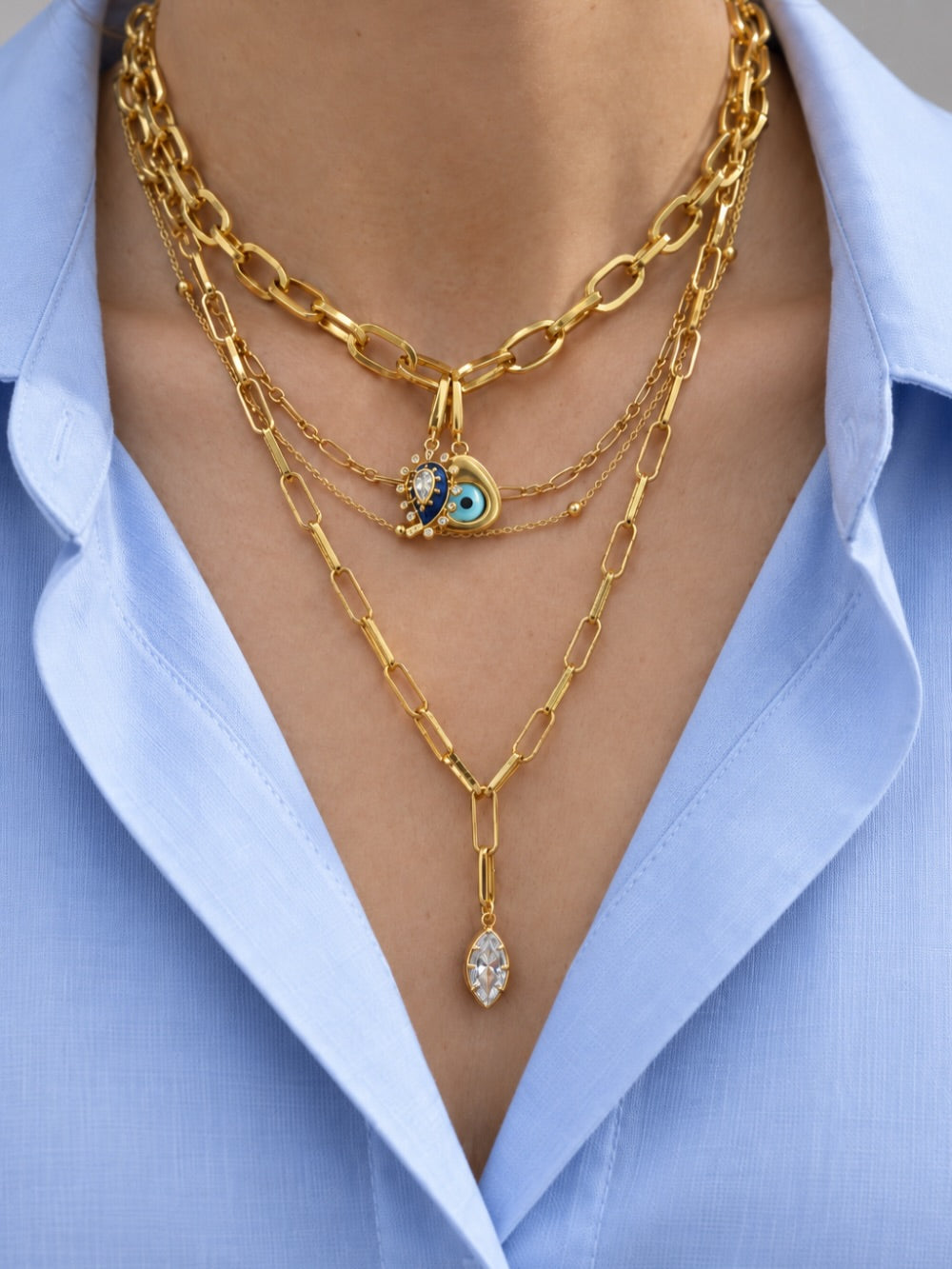
Layer by layer
The Lucky Layers
- Keep the stronger Cara chain close to the neck.
- Bring the blue eye charms and fine Catalina chain into the middle.
- Finish with the longer marquise paperclip combination.
Shop the pieces in this look
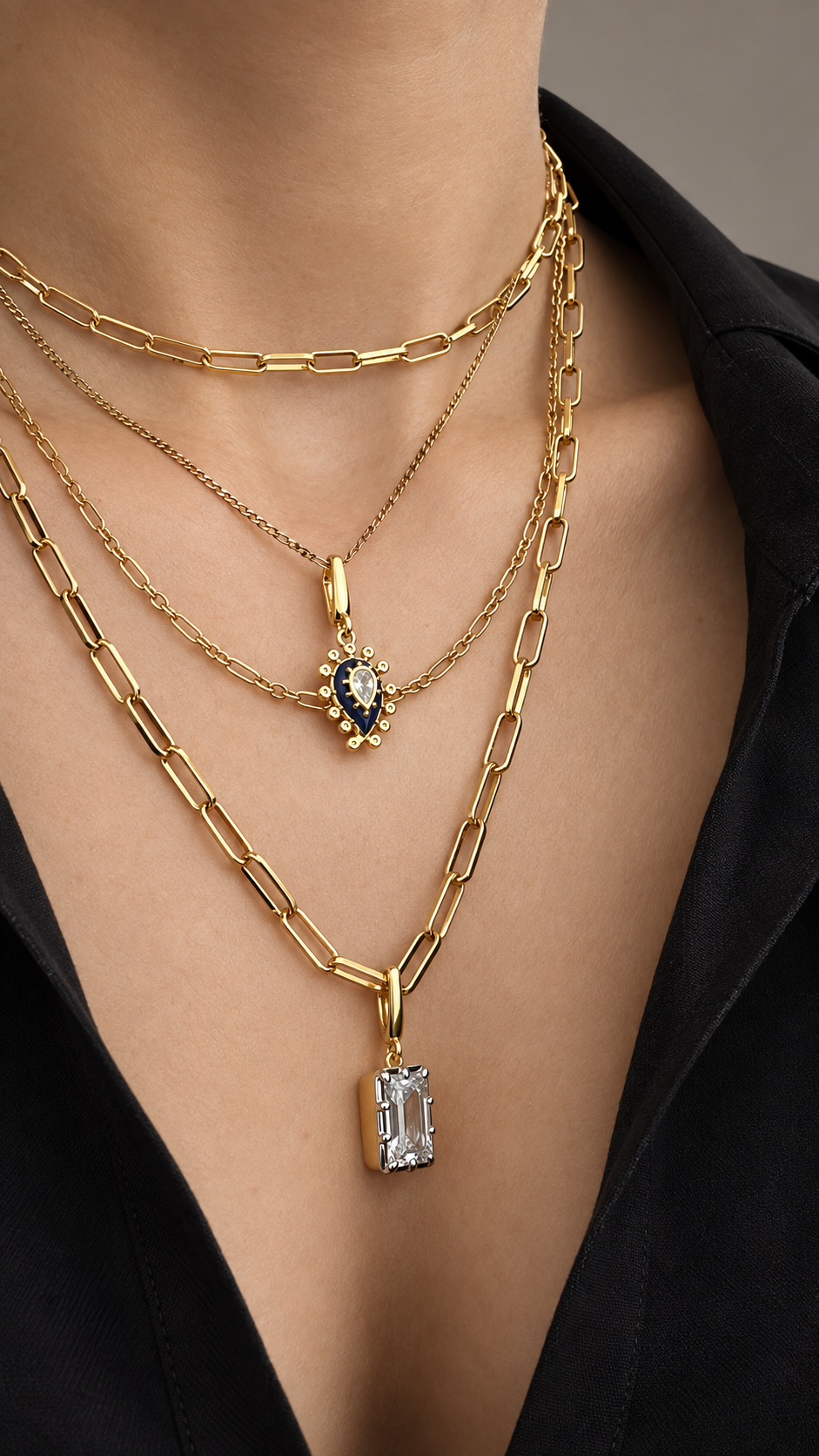
Layer by layer
The Perfect Layers
- Start with a 35 cm Large Link chain to frame the neckline.
- Add Scarlett, Catalina and a Paisley detail through the middle.
- Choose the emerald-cut paperclip combination at 50 cm below them.
Shop the pieces in this look
05 / Keep the contrast connected
How to mix gold
and silver necklaces.
- Choose your starting finish. Build most of the chain lines in gold or silver tones, then add a contrasting detail.
- Repeat the second finish. A mixed-metal charm, a second chain or a ring can make the contrast feel deliberate.
- Vary the scale. Pair a finer chain with larger links rather than matching every necklace.
- Check the centre. Keep the pendants distinct so different finishes and shapes remain visible.
You can reverse the balance, too: gold chains with silver-tone details work just as well as a silver base with gold accents. The colour describes the look; check each product for its base metal and plating.
The Looks / 5 combinations
Silver layers. Mixed-metal details.
Fine silver-tone chains, larger links and a gold accent offer different ways into the same idea. Repeat a finish or shape to connect the layers.
Layer by layer
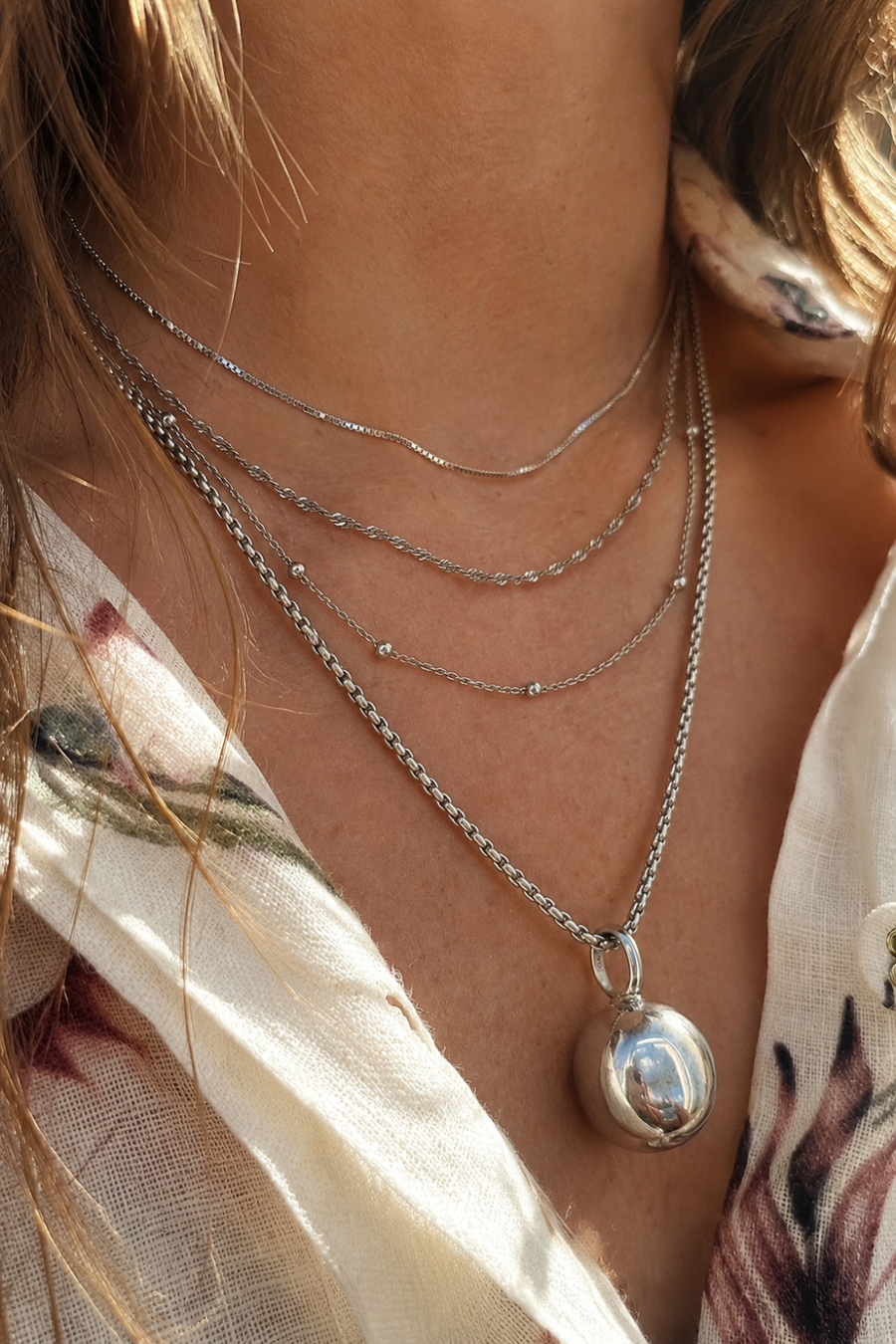
The Silver Layers
- Combine Box, Twisted and Charlotte for three fine textures.
- Stagger their positions using the 5 cm extenders.
- Let the Riva sphere necklace sit lowest as the focal point.
Shop the pieces in this look
Layer by layer
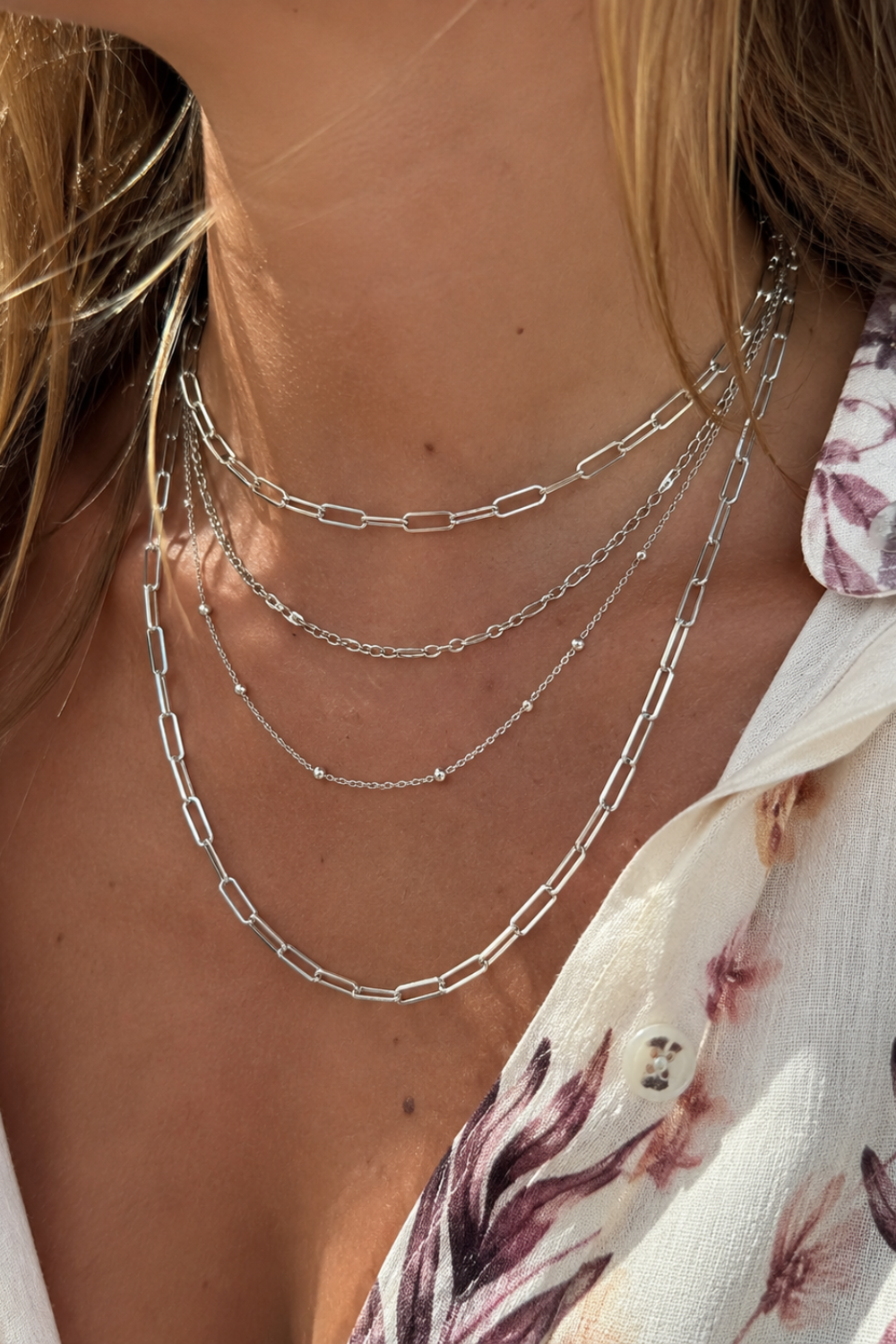
The Silver Link Layers
- Wear one Large Link chain at 35 cm.
- Place the finer Catalina and Charlotte chains between the bold links.
- Add a second Large Link chain at 50 cm.
Shop the pieces in this look
Layer by layer
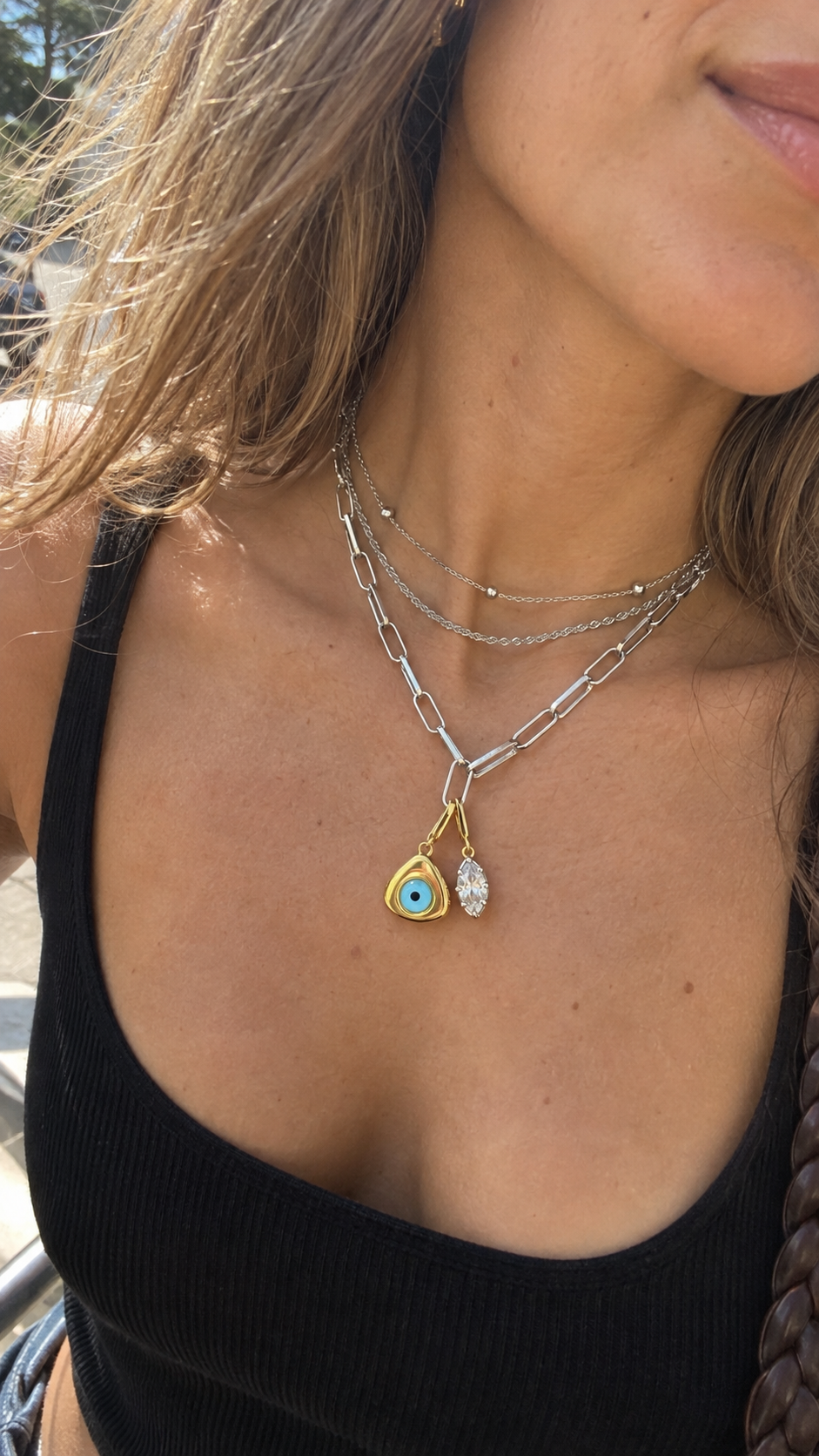
Cool Silver Necklace Layers
- Start with the silver-tone Charlotte and Twisted chains.
- Place the paperclip chain slightly lower.
- Add the Triangle Evil Eye and mixed-metal marquise charms.
Shop the pieces in this look
Layer by layer
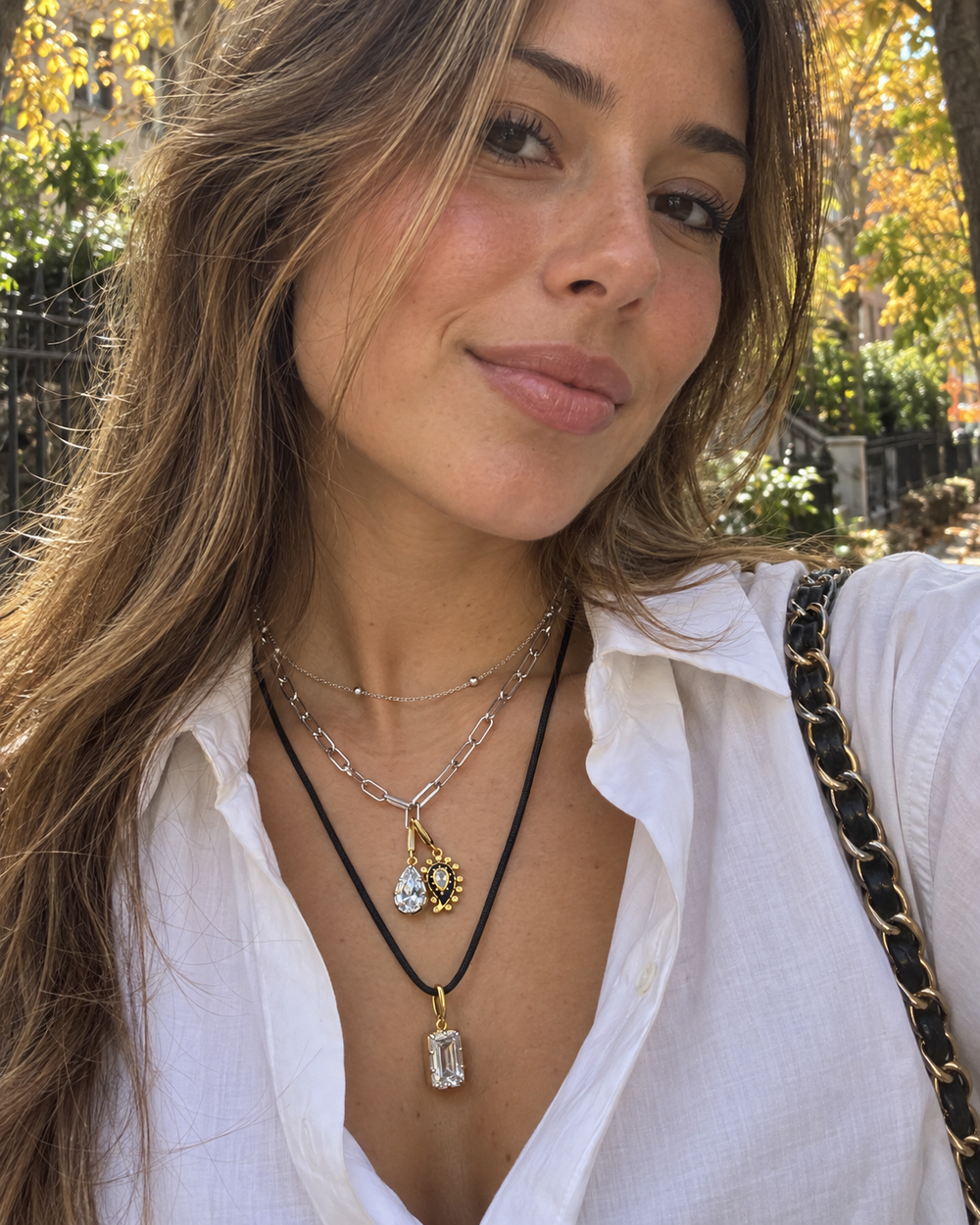
Lucky Mixed-Metal Layers
- Use Charlotte to create a fine upper line.
- Add the silver paperclip chain with a teardrop and Paisley charm.
- Wear the cord with an emerald-cut charm below the chains.
Shop the pieces in this look
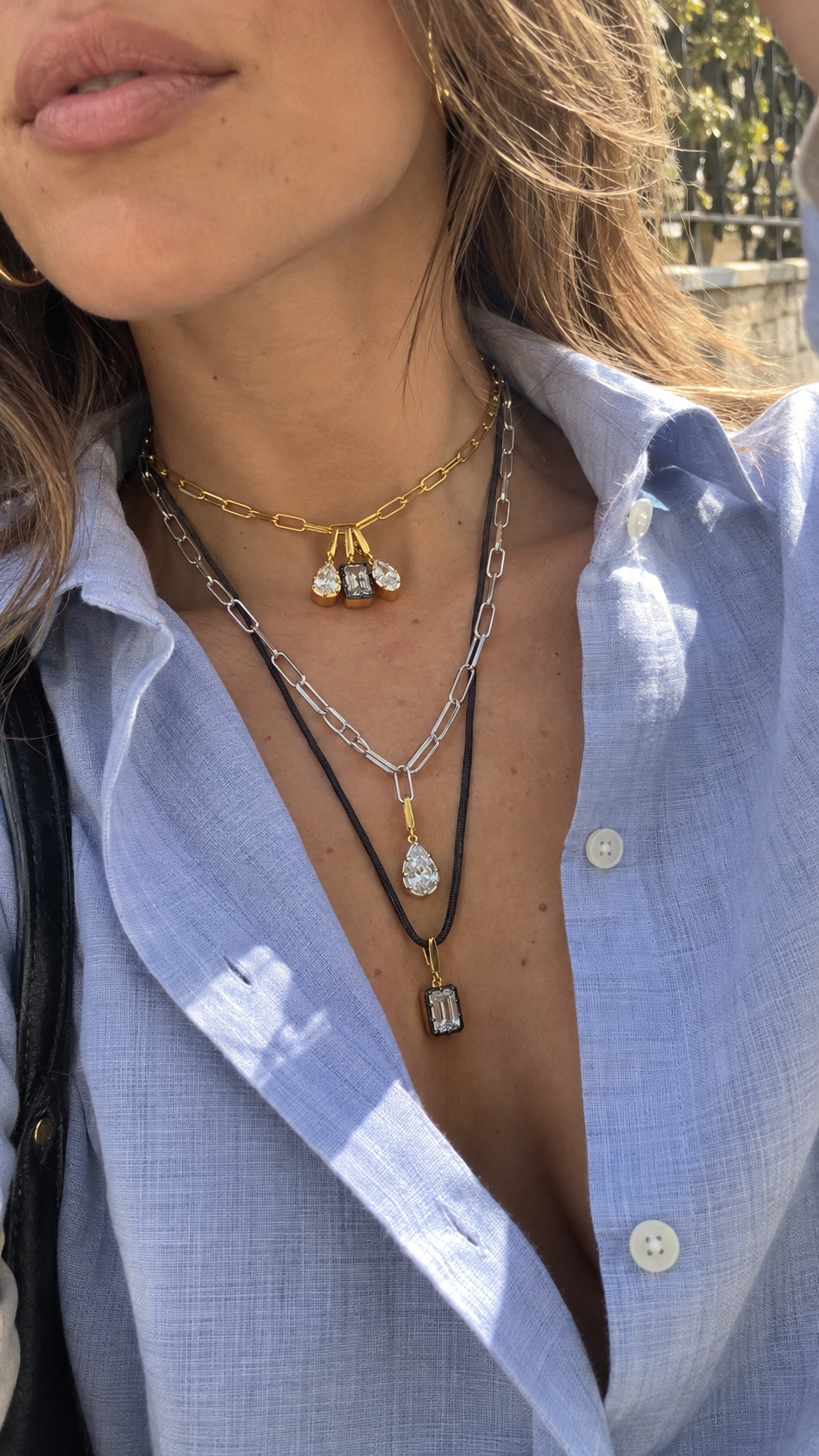
Layer by layer
Mixed-Metal Layers with Vittoria
- Combine gold links with the silver paperclip necklace.
- Spread the Vittoria details between the two metal layers.
- Use the cord and emerald-cut combination for a third texture.
Shop the pieces in this look
06 / Change the base
How to layer
cords and charms.
- Set the cord position first. Decide whether it will be the shortest line, the middle layer or the longest pendant.
- Add one metal chain. Use the difference in texture to define the two necklaces.
- Check the charm attachment. Choose a compatible opening hook and make sure it closes fully. A closed-loop pendant may not pass over every chain clasp.
- Leave the cluster some room. If the cord carries several charms, keep the neighbouring necklace simpler.
Our adjustable cord is very dark chocolate brown and can appear almost black in photographs. It adjusts up to approximately 70 cm; use the product page to check the current colour and fittings.
For more on choosing a base and arranging charms, read how to wear multiple charms on a necklace.
The Looks / 7 combinations
A dark cord changes the whole look.
Use a cord to draw a different line between metal chains. Wear it high, take it lower or let a small group of charms sit together at the centre.
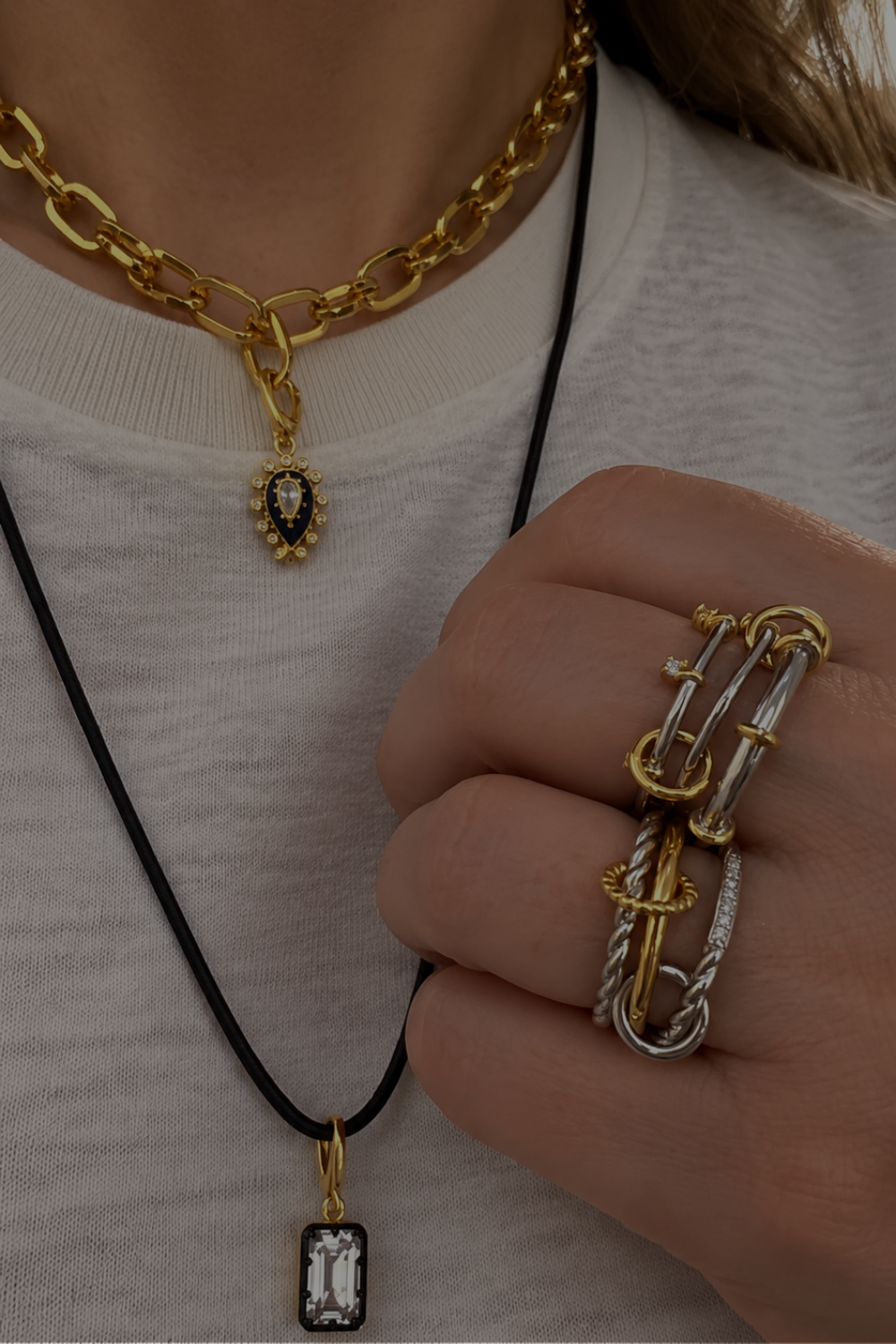
Layer by layer
Dimitra’s Daily Rotation: Cord + Cara
- Start with the cord and emerald-cut Vittoria combination.
- Add the Cara and Paisley necklace higher on the neck.
- Repeat the metal mix with the linked rings, if you want the full look.
Shop the pieces in this look
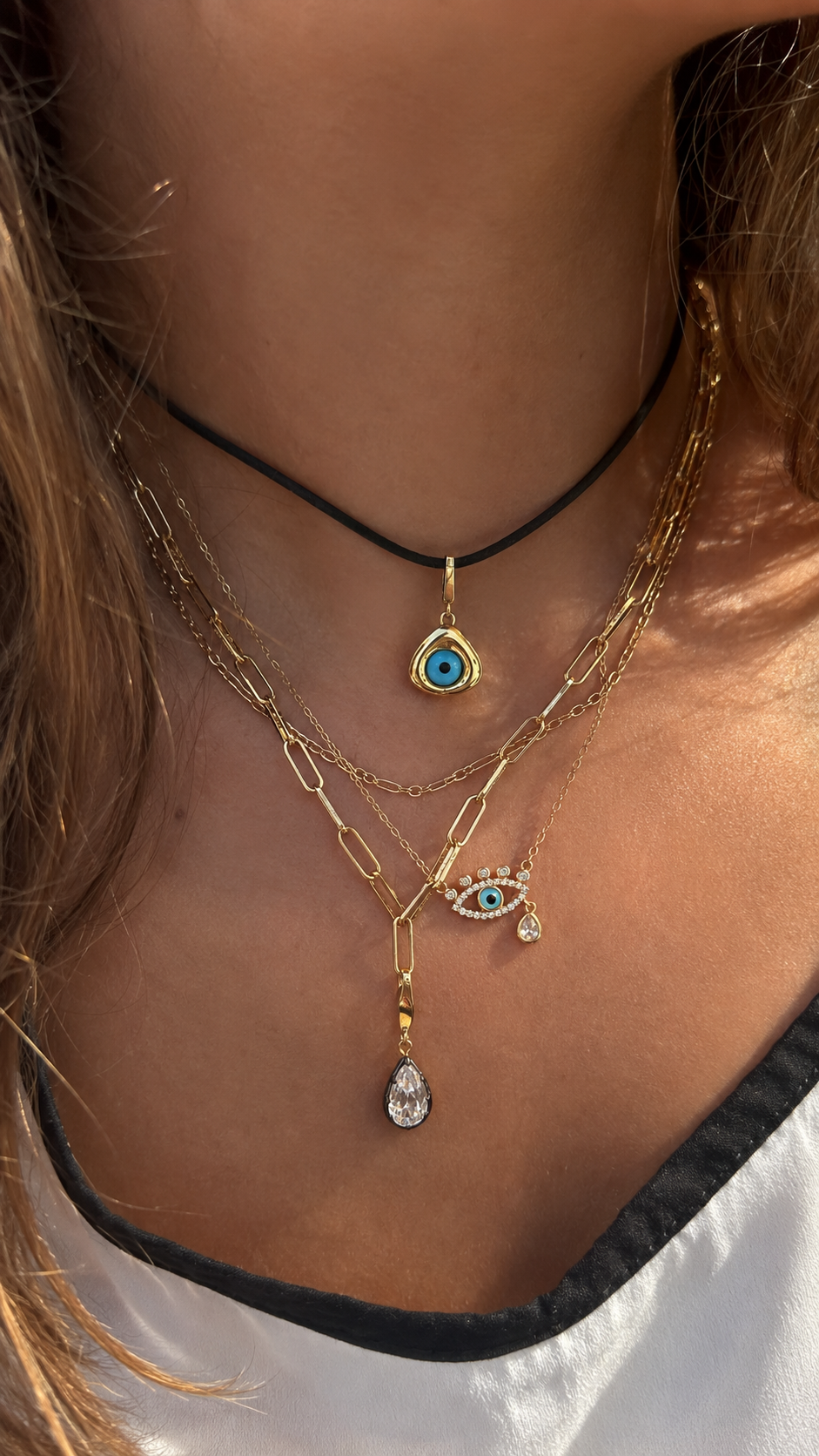
Layer by layer
The Evil Eye Layers
- Wear the cord and Triangle Evil Eye as the shortest line.
- Add Catalina and the Weeping Evil Eye necklace underneath.
- Finish with the paperclip and Vittoria teardrop combination.
Shop the pieces in this look
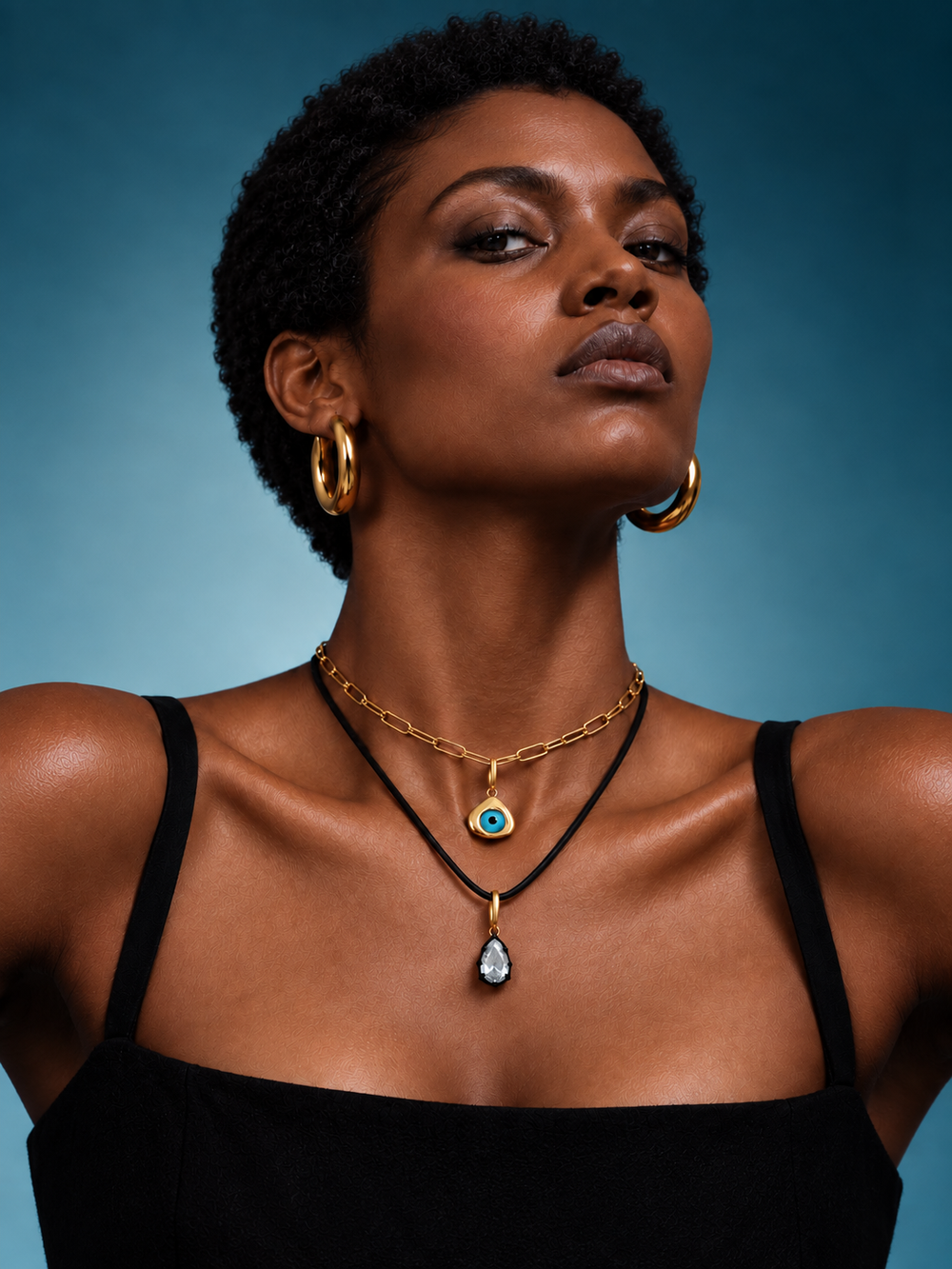
Layer by layer
Power Play: Hoops & Layers
- Position the paperclip and Triangle Evil Eye at the neckline.
- Take the cord and Vittoria teardrop lower.
- Add the Bella hoops to carry the gold finish up to the face.
Shop the pieces in this look
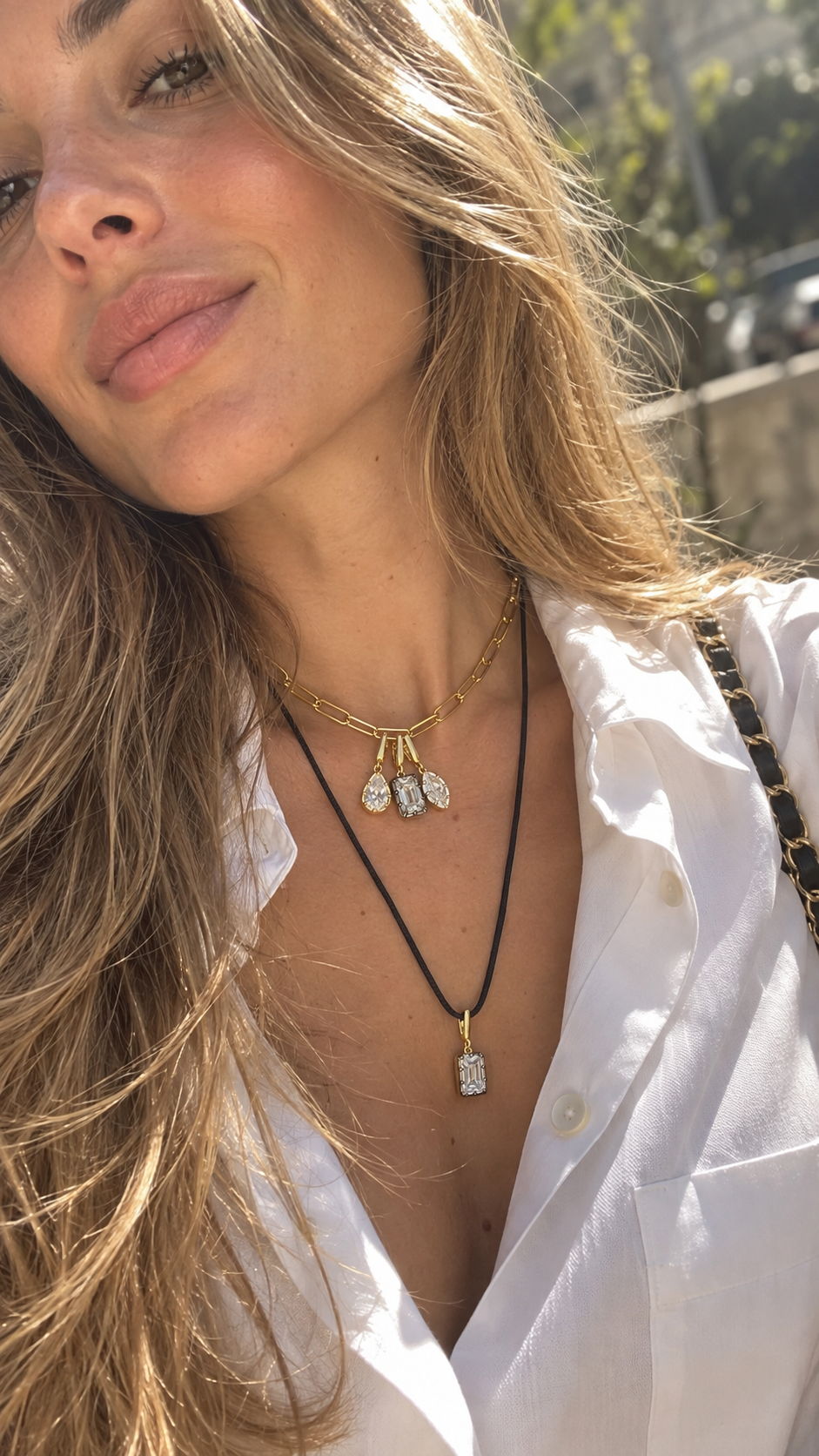
Layer by layer
The Everyday Vittoria Layers
- Arrange three Vittoria charms on the shorter gold link chain.
- Wear the cord and emerald-cut combination below it.
- Leave a clear gap between the upper cluster and lower pendant.
Shop the pieces in this look
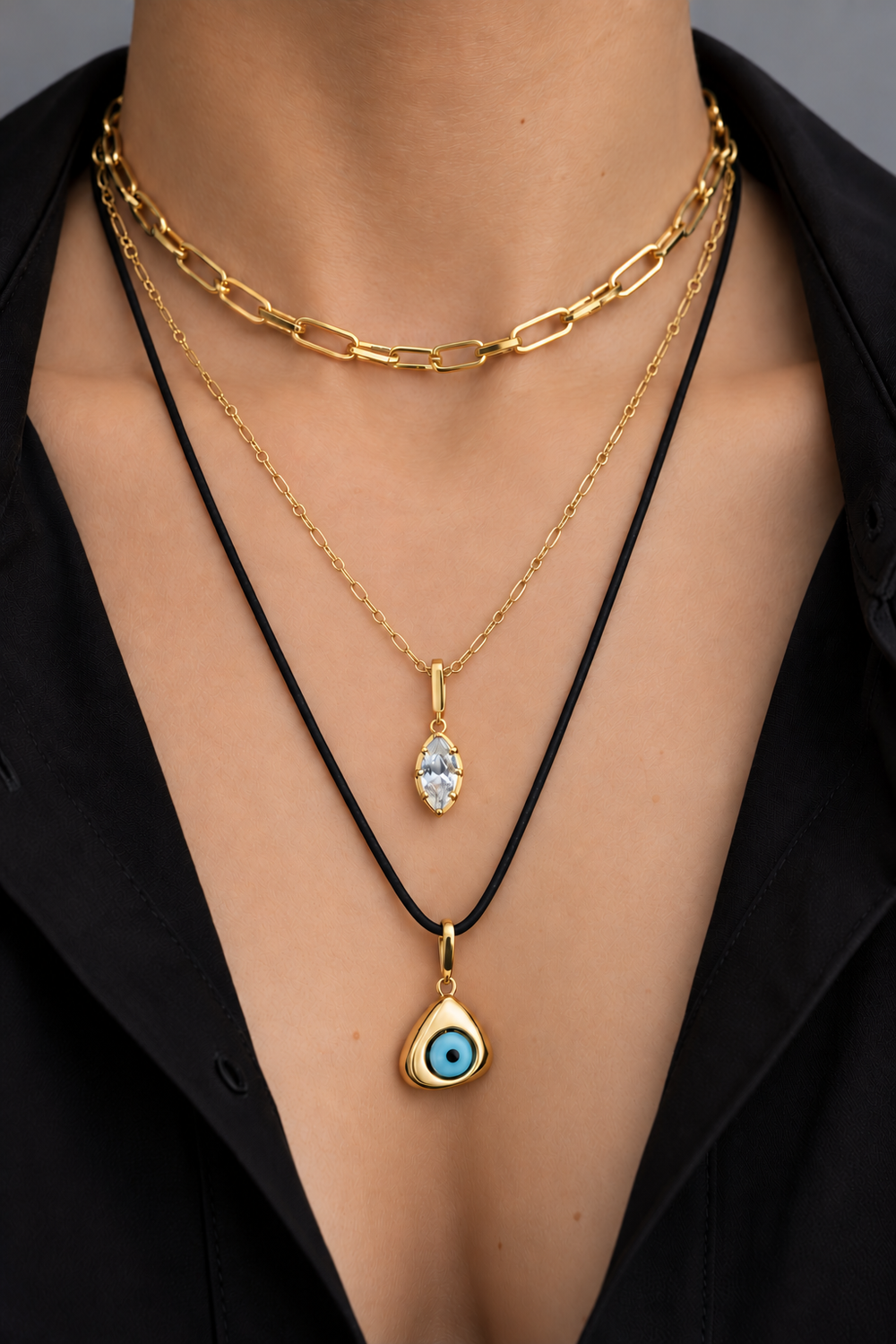
Layer by layer
The Protection Layers
- Set the Cara chain at 35 cm.
- Add Catalina and the small marquise detail through the middle.
- Wear the cord and Triangle Evil Eye as the longest layer.
Shop the pieces in this look
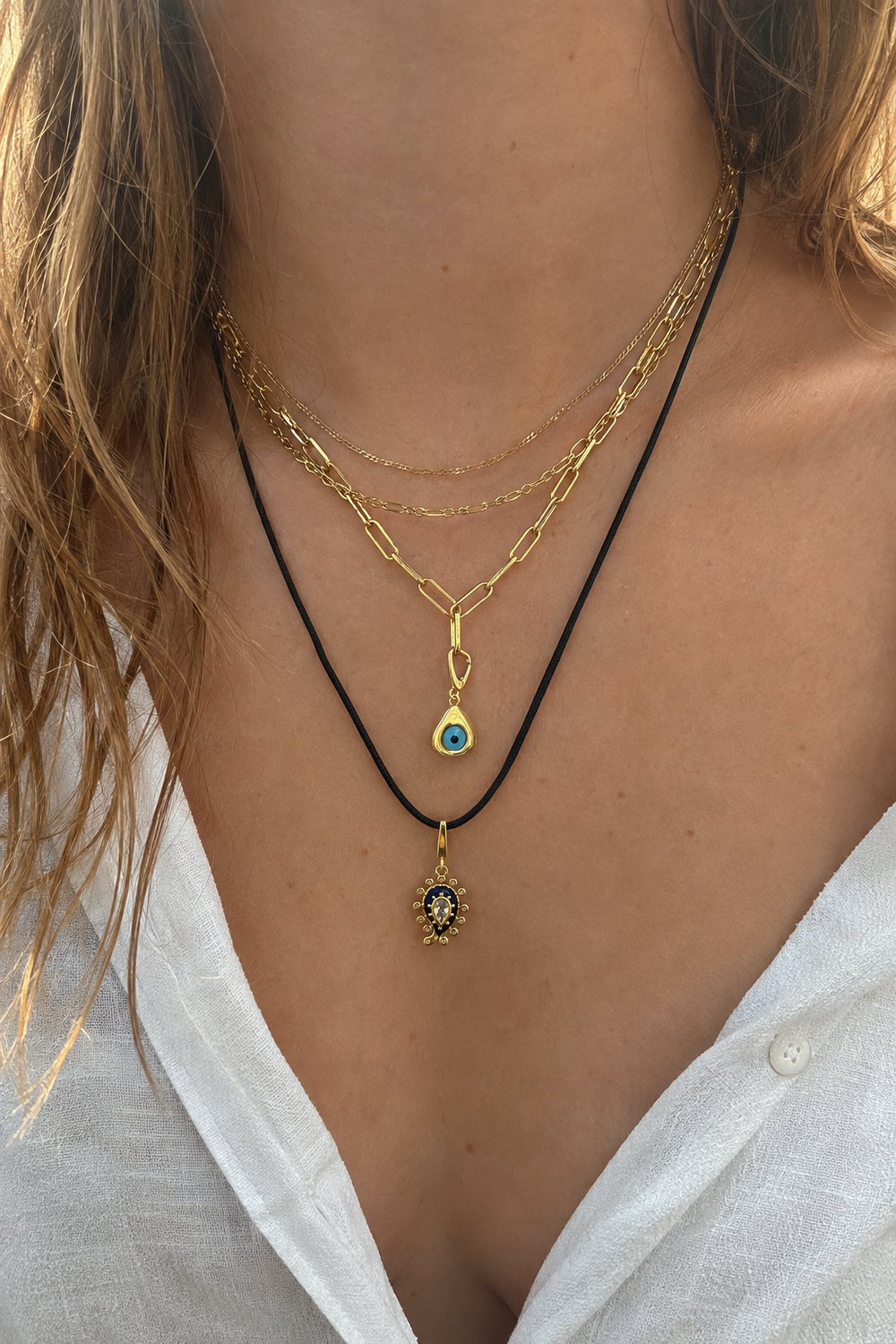
Layer by layer
The Talisman Layers
- Keep Scarlett and Catalina as the fine upper lines.
- Choose the paperclip and Triangle Evil Eye at 40 cm.
- Wear the Paisley cord combination below the metal chains.
Shop the pieces in this look
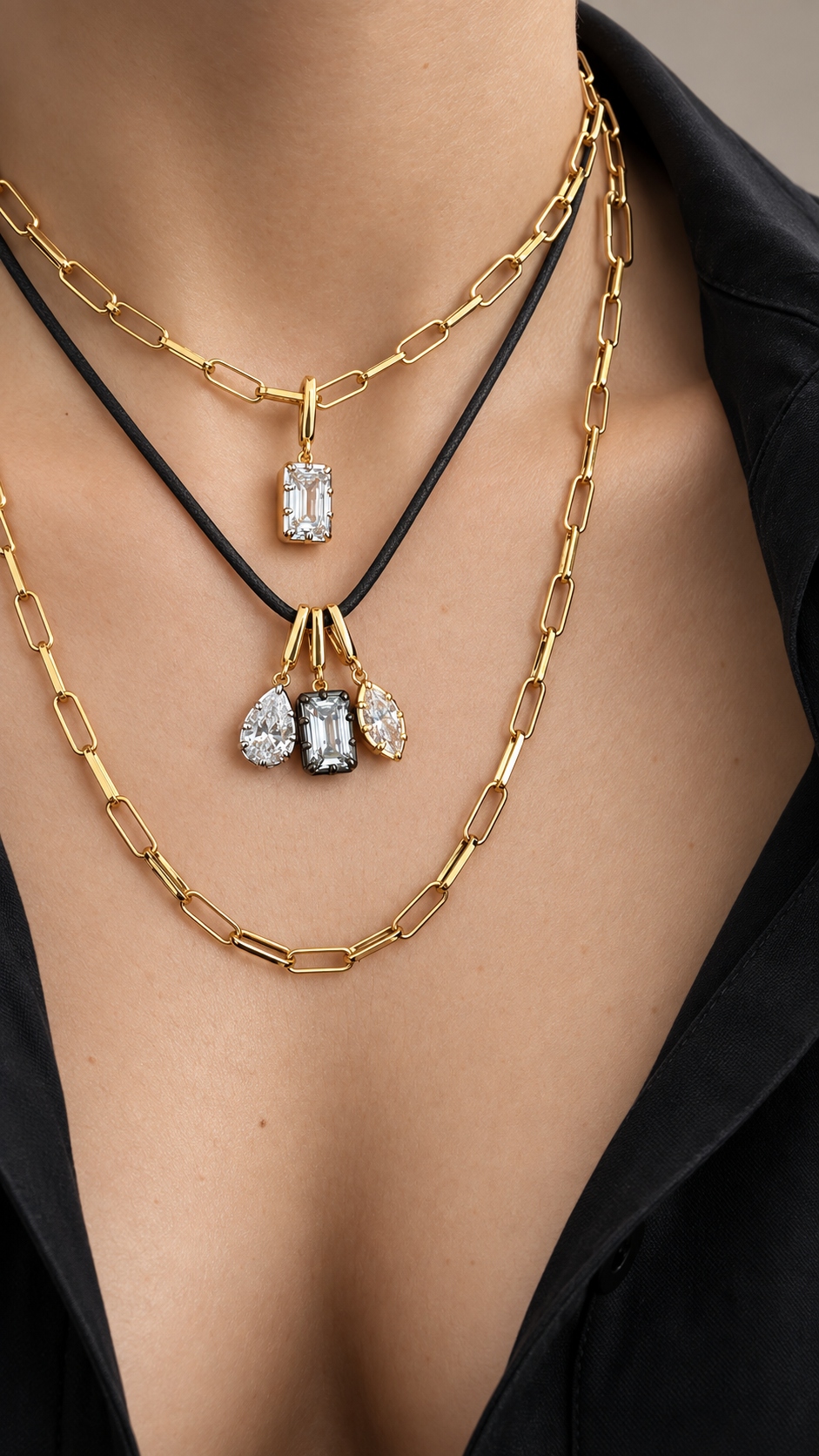
Layer by layer
The Triple Vittoria Necklace Layer
- Frame the neckline with gold links at 35 cm and 45 cm.
- Position the cord between the two chain lines.
- Group the Vittoria charms on the cord and keep the lower chain clear.
Shop the pieces in this look
The Looks / 6 combinations
Start with one. Add a layer later.
These six looks centre on a single necklace. Use one as your base, or enjoy the simpler line as it is. Several charms on one chain are a charm arrangement; adding a second necklace creates a layered look.
One necklace / Build from here
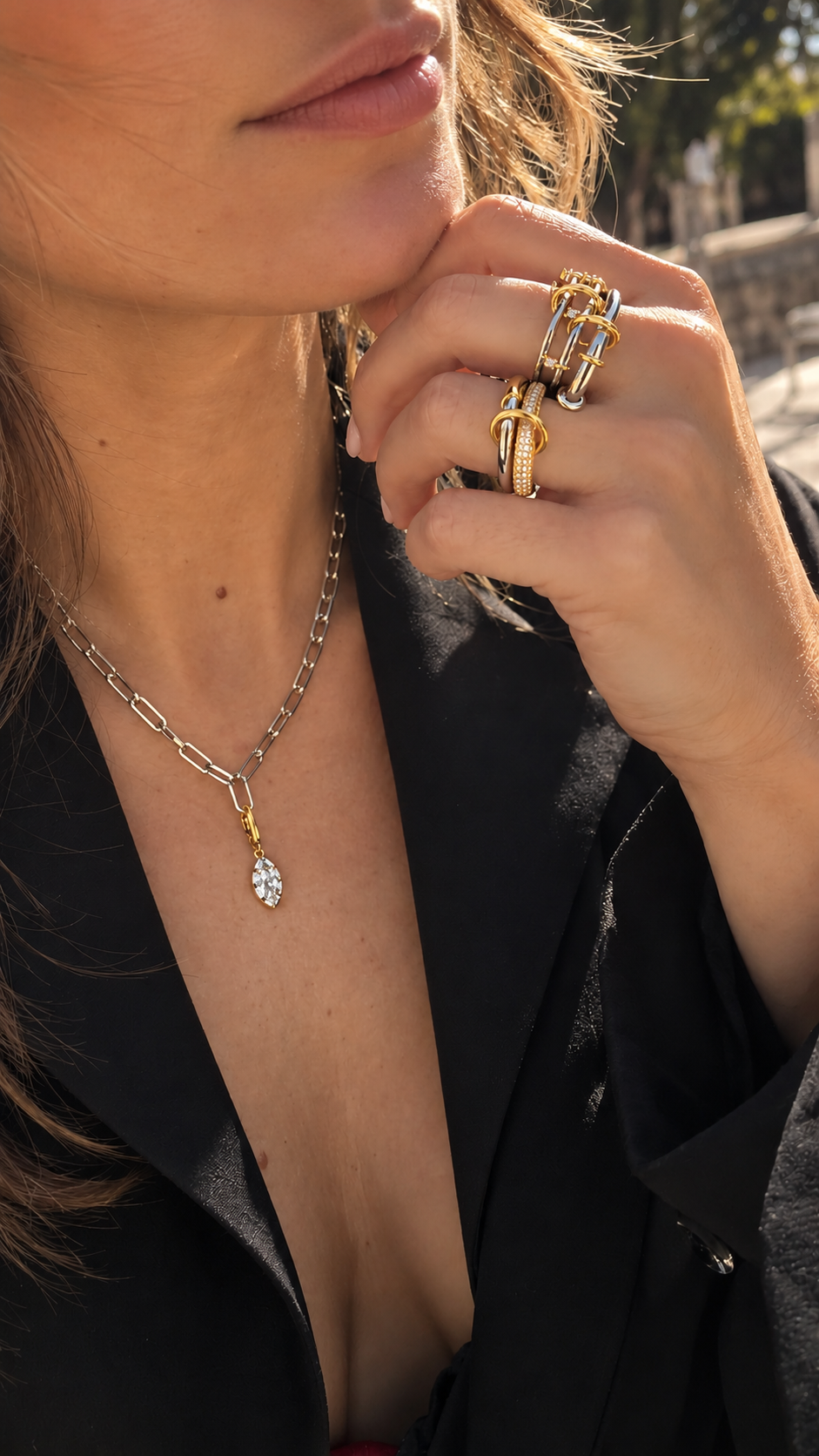
Mixed Metals: Neck to Fingers
- Start with a silver paperclip chain and mixed-metal marquise charm.
- Repeat the gold and silver tones in the linked rings.
- For an extra neck layer, add a fine chain at a different length.
Shop the pieces in this look

One necklace / Build from here
The Gaga & Marquise Cord Look
- Adjust the marquise cord necklace to sit at your neckline.
- Balance the small pendant with Gaga’s larger hoop shape.
- Keep this single-necklace look simple, or add one fine chain below.
Shop the pieces in this look

One necklace / Build from here
The Luna & Vittoria Emerald Cut Look
- Choose the emerald-cut Cara combination at 40 cm.
- Repeat the gold finish with the sculptural Luna hoops.
- Add a longer plain chain only if you want a second necklace line.
Shop the pieces in this look

One necklace / Build from here
The Three Platings Vittoria Cord Look
- Keep the adjustable cord as the single necklace base.
- Combine gold, white-rhodium and black-rhodium charm finishes.
- Give the cluster room before adding any other chain.
Shop the pieces in this look
One necklace / Build from here
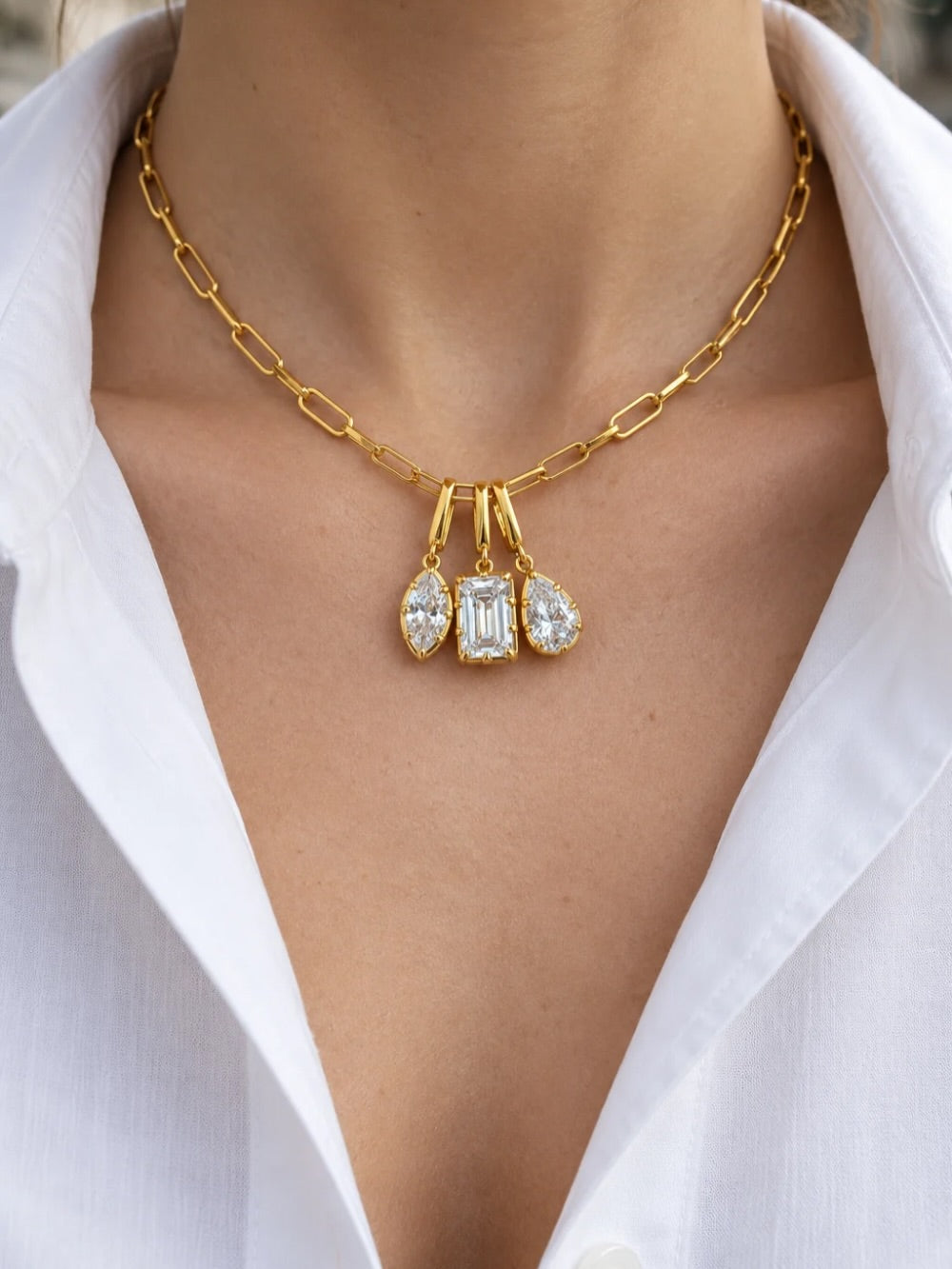
Triple the Charm: Gold
- Choose a gold Large Link chain at 40 cm.
- Group an emerald-cut, teardrop and marquise charm together.
- Keep the chain at one height, then add a longer fine necklace if desired.
Shop the pieces in this look
One necklace / Build from here
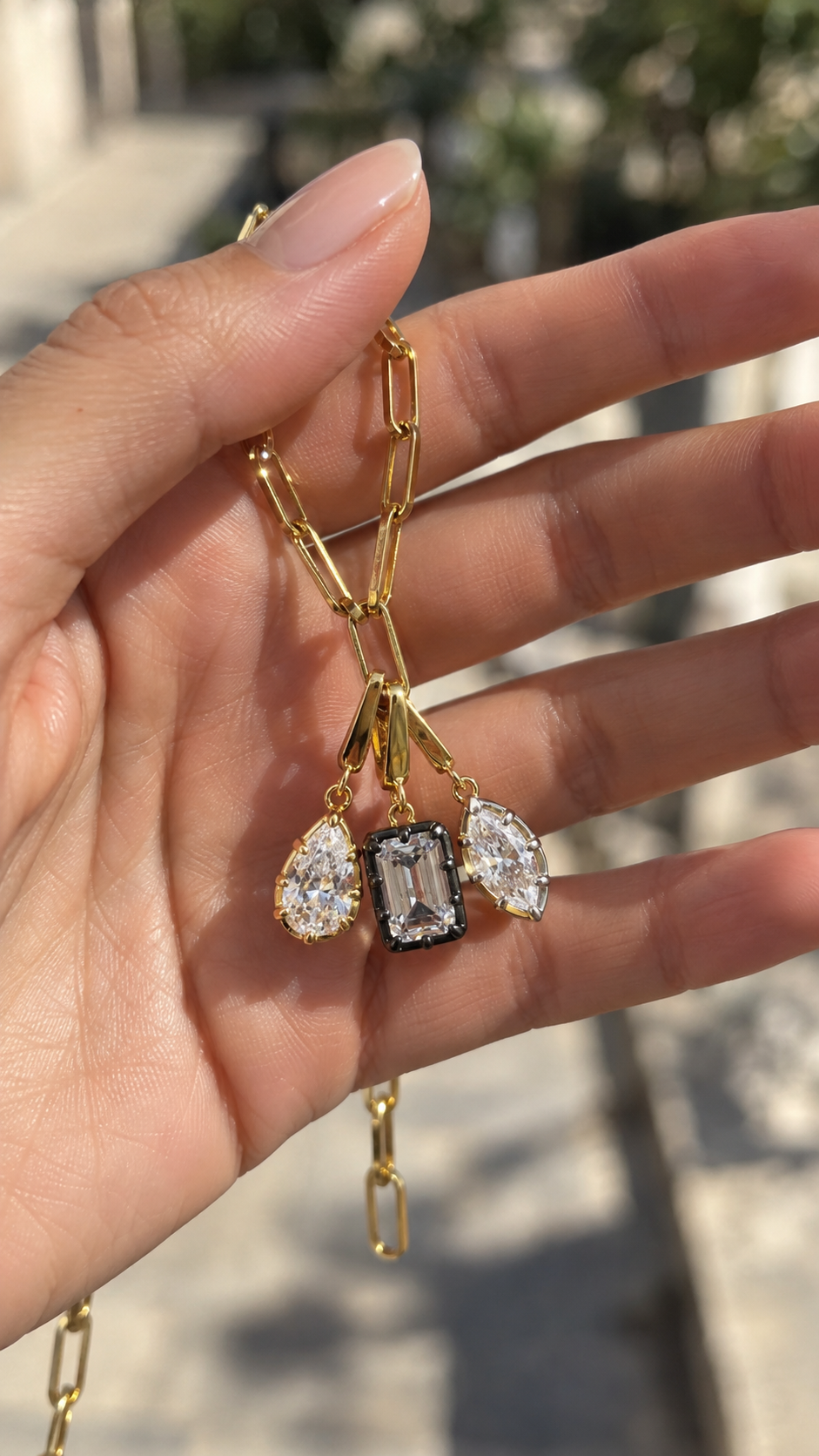
Triple the Charm: Mixed Finishes
- Start with the gold Large Link chain.
- Combine a teardrop, a darker emerald cut and a mixed-metal marquise.
- Use this single-chain cluster as the focal point for future layers.
Shop the pieces in this look
07 / Make the layers easier to wear
How to reduce tangling
and fix a crowded stack.
Different lengths and chain shapes can help layers stay separate, but no combination is completely tangle-proof. Movement, clasps and pendant positions still matter.
Two pendants land together.
Adjust one extender, change one chain length or remove a pendant. Remember that a longer charm hangs lower even when the two chains have the same measurement.
Fine chains twist together.
Try a larger gap or replace one with a wider link. Put each necklace on separately and check that the chains begin untwisted.
The whole look feels busy.
Keep the piece you love most, then remove one necklace. Replace a charm-covered layer with a plain chain if you still want the extra line.
A necklace catches your top.
Move it clearly above or below the neckline. Over knitwear, choose fittings and shapes that do not catch the weave.
You are considering a separator.
A necklace separator may help keep several clasps apart. Check that it fits the chains and remember that the extra fitting changes their finished length.
The chains are already tangled.
Open the clasps and place the necklaces on a soft, flat surface. Gently loosen the knot with your fingers, working from the outside. Avoid pulling hard or adding powders and oils to plated jewellery; ask a jeweller for help with a tight knot.
Store them separately. Put them on last.
Fasten each necklace before storing it in its own pouch or compartment. Put jewellery on after perfume and skincare, wipe it with a soft, dry cloth, and remove it before sleeping, showering, swimming or exercise. Separate storage helps prevent knots and scratching between pieces.
08 / Your layering questions
A few useful answers.
How many necklaces should I layer?
Start with two or three. Two make it easy to compare lengths and textures; three give you a short, middle and longer line. Four or more can work when you leave room for each piece, but there is no required number.
What necklace lengths work best together?
Try 35 and 45 cm for two clearly separated layers, or 35, 40–45 and 50 cm for three. Adjust for your neck, neckline and pendant size. The length table above links to photographed examples.
Can I wear two necklaces of the same length?
Yes, if you like a closer, gathered effect. They may overlap or twist, especially when both chains are fine. Use an extender on one necklace if you want more separation; different textures alone do not guarantee that they will stay apart.
Can I mix gold and silver necklaces?
Yes. Use one finish as the main chain colour, then repeat the other in a charm, another necklace or a ring. The silver and mixed-metal looks above show several ways to do it.
Can I layer a zodiac or initial necklace?
Yes. Keep the personal pendant as the focal point and add a plain chain at a different height. Our zodiac jewellery guide explains which zodiac pieces include a chain and which are separate charms.
Are three charms on one chain the same as three layered necklaces?
No. Three charms on one chain form a single necklace with a cluster of pendants. Necklace layering uses two or more separate necklaces. Either can be your starting point.
Do I need to buy every piece in a look?
No. Open the look page, choose your lengths and select the pieces you need. Check whether a listed product already includes its chain and charm. Where the photo uses the same chain twice, choose two necklaces in the appropriate lengths.
Your next layer
Start with what you love.
Add something that works with it.
A fine chain, a stronger link, a little colour or a different finish. The best next piece has a place in the jewellery you already wear.


