





built in.
A good ring stack looks effortless, but getting the proportions right can take more thought than it appears. Different widths have to sit together, gold and silver need to feel intentional rather than accidental, and a touch of pavé has to add light without making the whole hand feel overdone.
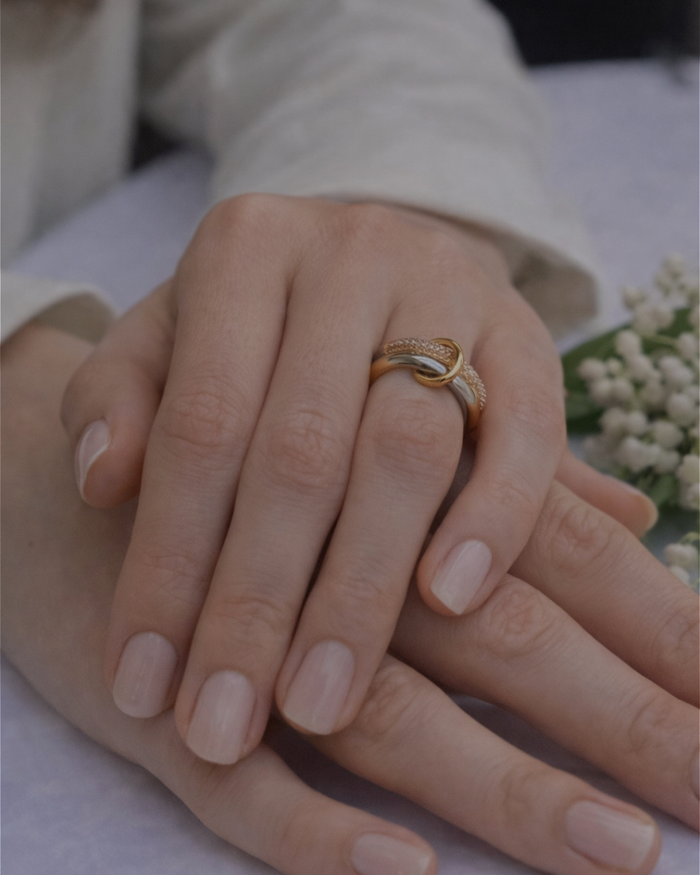
Multi-band rings do that work in a single piece. Two, three or more bands are composed together to create the look of a considered stack — already balanced, already styled, and ready to wear as one ring.

What is a multi-band ring?
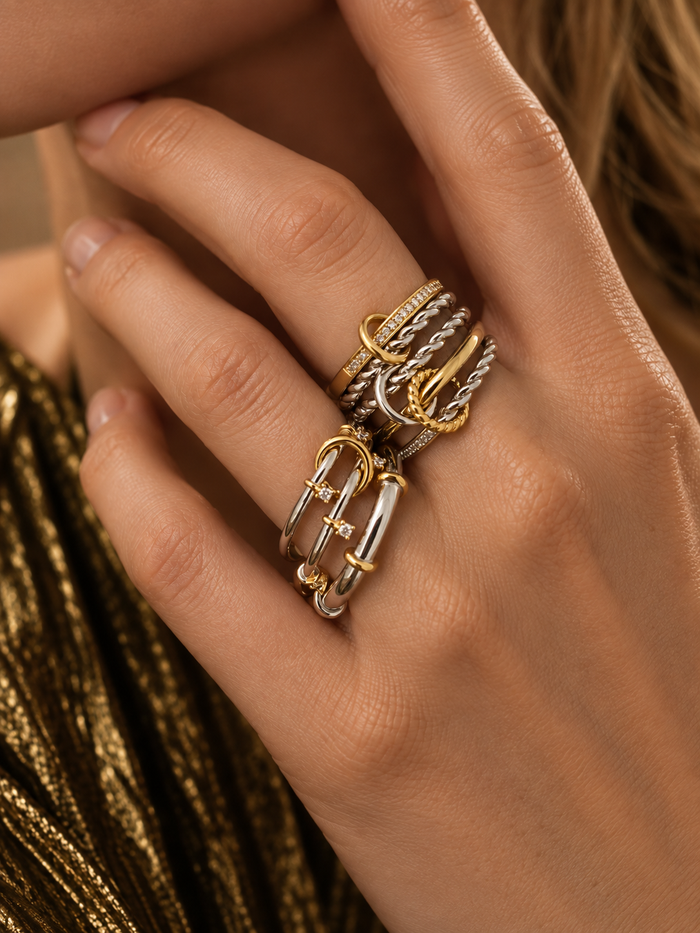
A multi-band ring is designed with two or more bands working together as one composition. The bands may sit parallel, cross over one another, twist, overlap or meet at a central detail. Some designs use one metal throughout; others combine gold and silver tones or introduce pavé for contrast.
The result is similar to a ring stack, but the styling is built into the piece. Instead of choosing several separate rings and adjusting them throughout the day, you put on one ring and the proportions are already resolved.
Multi-band rings are sometimes searched for as linked rings or connected band rings. The terminology varies, but the idea is simple: multiple bands are brought together in one sculptural design to create the look of a layered ring stack.


THE STACK,
BUILT IN.
The ring stack is already styled.
The appeal is not that a multi-band ring replaces stacking. It gives you another way to get the same layered effect when you want less effort and more control.
A built-in stack can make a single ring feel substantial without needing several separate pieces. It also creates deliberate negative space between bands, mixes smooth and textured surfaces more precisely and keeps pavé or contrasting metal exactly where the design intended it to sit.
For Galleria Armadoro, this is the point: the ring stack is already styled. The design arrives with its own rhythm, proportion and mix of finishes, so the decision is simply whether to wear it alone or build around it.

Double-band, triple-band, two-tone.
Double-band rings use two bands to create a cleaner, more minimal stacked effect. The spacing becomes part of the design: the visual impact of two rings, resolved as one.
Triple-band rings have more volume and a stronger stacked presence. Three bands allow different textures, profiles and finishes to sit together without building the combination piece by piece.
Two-tone and mixed-metal rings combine gold and silver tones in one design, connecting jewellery you already own in both metals rather than forcing you to choose one.
Multi-band pavé rings use stones as one layer of the composition rather than treating sparkle as the whole point — a line of light within the structure.


How do you get the stacked-ring look with one ring?
Start with a ring whose bands already vary in width, texture or finish. That variation is what makes a single piece read like a stack rather than one heavy band.
A twisted band beside a polished one creates texture. A pavé line beside a plain surface creates light. Gold beside silver creates colour contrast. When those elements are built into one ring, the eye reads several layers even though you are wearing one piece.
If you want the strongest “stacked” effect, choose a triple-band or more sculptural multi-band design. If you prefer something quieter, a double-band ring gives the same layered idea with more negative space and less visual weight.

Can you wear gold and silver rings together?
Yes. The easiest way to make mixed metals look intentional is to repeat both tones rather than treating one as an exception.
A two-tone multi-band ring does this automatically. Because gold and silver already appear within the same piece, it acts as a bridge between the rest of your jewellery. A silver watch can sit comfortably with gold hoops; a gold bracelet can work with a silver ring; the mixed-metal ring gives the eye a reason for both finishes to be there.
There is no need to divide your jewellery into a “gold day” and a “silver day”. The more useful question is whether the proportions, shapes and finishes speak to one another.


Let the ring do the styling.
Wear it alone.A multi-band ring already has the presence of several pieces, so one strong ring on an otherwise bare hand can be enough.
Balance the other hand.If the ring is substantial, try a slimmer band or signet on the opposite hand rather than building an equally heavy stack beside it.
Repeat one detail.Pick up the pavé, twisted texture or metal tone somewhere else — a small hoop, bracelet or second ring — without becoming too matched.
Use two-tone as the bridge.When the rest of your jewellery mixes metals, a gold-and-silver ring can make the entire combination look deliberate.
Leave some space.More rings do not always mean a better stack. Leaving one or two fingers bare can make a sculptural multi-band ring look stronger.


A pre-styled ring stack removes the friction.
The best everyday jewellery removes friction. A pre-styled ring stack gives you the visual complexity of layering without needing to rethink the combination every time you get dressed.
It is especially useful if you like a more sculptural hand but do not want several loose rings moving independently. It also makes mixed-metal styling easier because the relationship between gold, silver and pavé has already been designed into the piece.
That is why we think of these rings less as a trend and more as a styling format: one piece, several visual layers, and enough character to work with the jewellery you already own.

answered.
What is a multi-band ring?
A multi-band ring combines two or more bands within one design. The bands can be parallel, crossed, twisted, overlapping or joined by a central element, creating the visual effect of a layered ring stack in one piece.
How can I get the stacked-ring look without wearing several rings?
Choose a double-band, triple-band or sculptural multi-band ring with variation in texture, width, metal tone or pavé. Those contrasts create the appearance of multiple rings while you are wearing a single piece.
Can I wear gold and silver rings together?
Absolutely. A two-tone ring is one of the easiest ways to make gold and silver look intentional together because both finishes already appear in the same design. You can then repeat either metal elsewhere in your jewellery.
What is the difference between a double-band and a triple-band ring?
A double-band ring uses two bands and tends to create a cleaner, more open stacked effect. A triple-band ring uses three bands, giving the design more volume and more opportunity to mix textures, finishes or pavé.
Are multi-band rings the same as linked rings or connected band rings?
The terms can overlap in search and everyday use. “Linked” or “connected” may describe the way individual bands meet, while “multi-band” is the broader styling term for a ring built from multiple bands. At Galleria Armadoro, we use multi-band and stacked-look to describe the result most clearly: the look of a ring stack, built into one piece.
Can a multi-band ring be worn every day?
Yes, depending on the design and your routine. For everyday wear, choose a profile that feels comfortable on your hand and treat plated finishes and pavé with the same care you would give the rest of your jewellery.
already styled.
You can still add another ring. You can still mix metals. You can still change the balance from one hand to the other. The difference is that the starting point is already done.


