



GALLERIA ARMADORO / THE JEWELLERY GUIDE
Gold hoops, decoded.
Gold hoop earrings have earned their place as a jewellery constant for a reason: the silhouette is simple, but the options are anything but. A small close-fitting hoop can almost disappear into an ear stack; a thick 2 cm hoop can read bolder than a slim 3 cm pair; and a large hollow hoop can look substantial without feeling substantial on the ear.
The short answer: the best gold hoop earrings are the pair that gets five things right for you — diameter, thickness, weight, material and fit. Choosing by “small, medium or large” alone misses half the story.
Updated September 2026. This guide is based on the way we design, fit and style hoops at Galleria Armadoro in Athens, with measurements and materials checked against our current collections. Always check the individual product page for the exact specification of a particular pair.
THE QUICK READ
Gold hoop earrings at a glance
If you want the fastest route to the right pair, start with the relationship between the hoop and your ear rather than the trend of the moment.
| Hoop style | Typical GA size reference | How it wears | Best for |
|---|---|---|---|
| Huggie | Approx. 6.5–12.5 mm, depending on design | Sits close to the lobe or piercing | Second and third piercings, close-fitting stacks |
| Mini / small hoop | Around 20 mm / 2 cm | Compact, visible, easy to layer | Everyday wear and smaller hoop proportions |
| Medium hoop | Around 30 mm / 3 cm | More movement and presence | An everyday statement without going oversized |
| Large hoop | Around 50 mm / 5 cm | More drop, movement and visual impact | Statement styling |
| Chunky hoop | Any diameter | Defined by thickness and volume, not diameter alone | A sculptural, bolder silhouette |
These are useful references, not universal rules. Ear anatomy, piercing placement, hoop thickness and the way a closure sits can all change how the same millimetre measurement looks on two different people.
SEE THE HOOPS EDITTHE FIVE-POINT FORMULA
How do you choose the right gold hoop earrings?
Choose gold hoop earrings by looking at five things together: diameter, body thickness, actual weight, material and closure. Diameter tells you how far the hoop extends; thickness tells you how bold it looks; weight affects comfort; material affects finish and skin contact; and the closure determines how securely and closely the hoop sits.
The most common mistake is treating diameter as the whole definition of size. It is not. A slim 30 mm hoop can look more delicate than a rounded, chunky 20 mm hoop because the second pair has much more visual volume.
Diameter
How large the circle appears and how far it drops from the lobe.
Thickness
How slim, tubular, puffy or sculptural the hoop looks.
Weight
Whether that visual volume translates into physical weight.
Material
What the body and post are made from, plus the gold finish where applicable.
Fit
How the hoop meets your piercing, the space beneath the lobe and how it fastens.
If you already know you want a classic gold pair, browse the Gold Hoop Earrings collection. If you are still deciding between gold and silver, size and silhouette, the broader Gold & Silver Hoop Earrings edit is a better starting point.
SIZE, WITHOUT THE GUESSWORK
What size gold hoop earrings should you get?
For many people, 2 cm to 3 cm hoops are the easiest everyday range. Go smaller when you want the hoop to sit closer to the ear, and larger when you want more movement and visual impact. But always consider thickness alongside diameter: a chunky 2 cm pair can make a stronger statement than a thin 3 cm pair.


Huggies
The smallest, closest-fitting members of the hoop family. Particularly useful for second and third piercings and for building an ear stack without adding too much movement.
Galleria Armadoro’s current huggie range includes several compact size references, including 6.5 mm, 8.5 mm, 11 mm and 12.5 mm designs. The exact fit depends on anatomy and piercing placement.
SHOP HUGGIESCompact everyday
A 2 cm hoop gives you a classic circular silhouette without a lot of drop. In a slim profile it can feel refined and minimal; in a thicker profile it becomes much more sculptural.
SHOP MINI HOOPSMore presence
Around 3 cm is where a hoop begins to create more visible movement around the jawline while still being easy to style every day. A slim 3 cm hoop reads very differently from a rounded 3 cm tube hoop.
Statement scale
Around 5 cm gives you a larger silhouette, more movement and more visual space between the ear and the outer edge. If you love a large hoop but dislike heavy earrings, construction becomes especially important.
PROPORTION 101
Diameter and thickness are not the same thing.
Diameter tells you how large the hoop is; thickness tells you how bold the hoop looks. They work together, but they do different jobs.
The scale
Diameter is the overall size of the hoop. It affects the drop, movement and amount of space between your ear and the outside edge of the earring.
The volume
Thickness is the width of the hoop’s body. A small but very thick hoop can look more substantial than a larger, very slim hoop.


Imagine two hoops side by side. One is 30 mm in diameter with a very slim body. The other is 20 mm in diameter with a wide, rounded tube. The 30 mm pair is technically larger, yet the 20 mm pair may look more substantial because your eye reads the thickness, shine and volume of the metal first.
That is why we prefer to think in proportion, not just size. When shopping online, look for overall diameter, body or tube thickness, side-view photography, an on-ear image and the stated weight where provided.
EXPLORE CHUNKY HOOPSTHE WEIGHT QUESTION
Are chunky gold hoop earrings heavy?
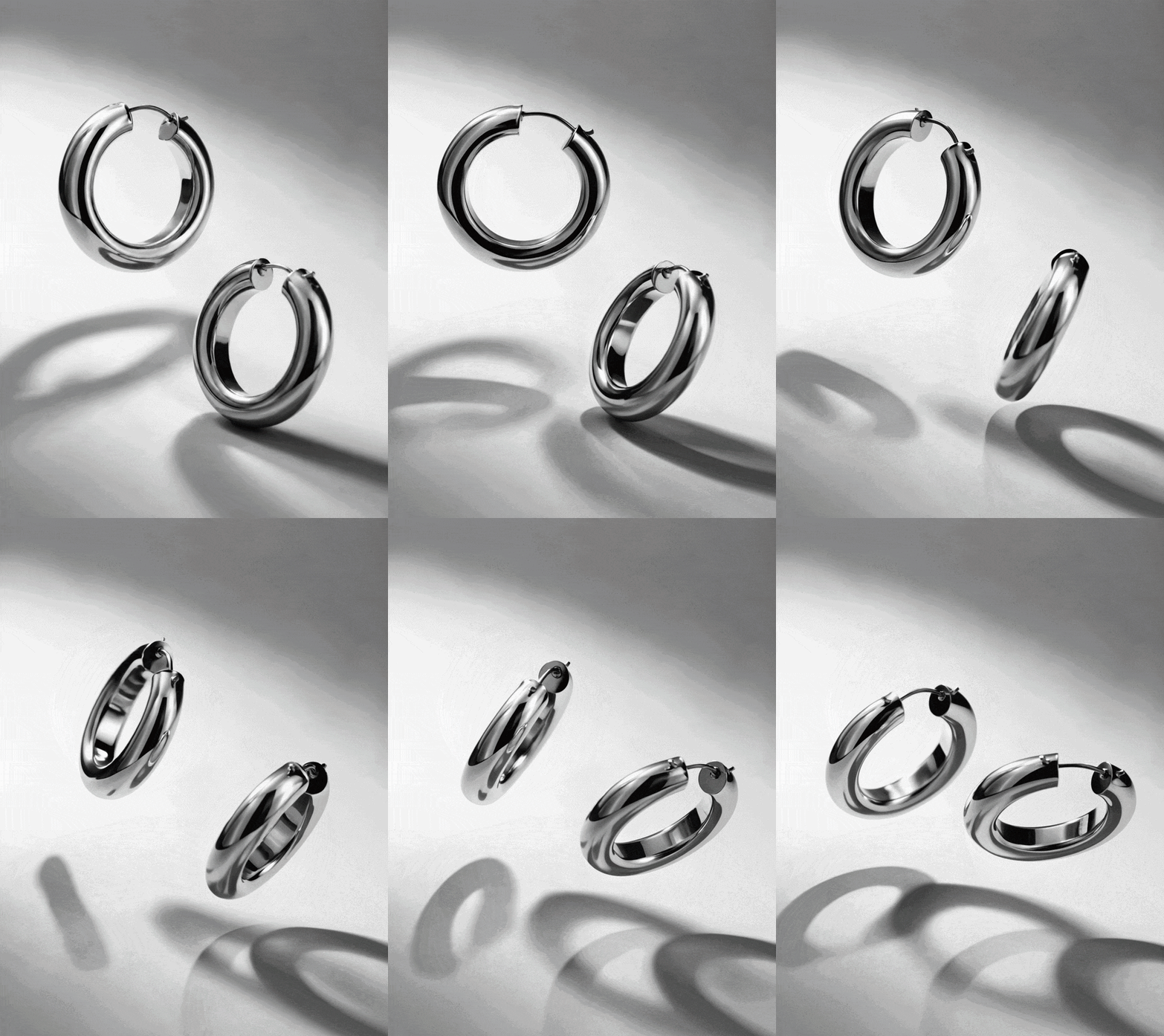
Not necessarily. “Chunky” describes the visual thickness of a hoop, not its weight. A chunky hoop can be hollow or tubular, allowing it to look rounded and substantial while using less material than a solid form of the same volume.
That does not mean every chunky hoop is automatically lightweight. Weight still depends on diameter, thickness, material and construction. If comfort is a priority, check the product specification rather than judging from the photograph alone.
This is one of the ideas that sits at the centre of Galleria Armadoro’s hoop design: volume should not automatically mean an uncomfortable ear.
READ THE CHUNKY HOOP GUIDEKNOW WHAT YOU ARE BUYING
What are gold hoop earrings made from?
“Gold hoop earrings” describes a colour and jewellery category; it does not automatically mean solid gold. Gold hoops can be made from solid gold, gold vermeil or another metal finished with gold plating. The useful question is: what is the base metal, what is the post made from, and what is the finish?
Solid gold
Solid gold jewellery uses a gold alloy throughout the piece. Carat tells you the proportion of pure gold in that alloy. This is a different product category from plated jewellery and usually sits at a significantly higher price point.
Gold vermeil
Gold vermeil generally refers to sterling silver coated with gold, subject to the relevant standards in the market where it is sold. If a product is described as vermeil, check the exact specification rather than assuming every gold-coloured silver piece is the same.
Gold plated
Gold plating applies a layer of gold over another base metal. The base may be sterling silver, brass or another suitable jewellery metal, depending on the design.
THE GA SPECIFICATION
What Galleria Armadoro uses now
Across Galleria Armadoro’s current hoop collection, the body can be 925 sterling silver or brass depending on the design, while the posts that pass through the piercing are 925 sterling silver. Many current gold styles use a polished 24ct gold-plated finish, and selected designs specify approximately 1.5-micron 24ct gold plating. Always use the individual product page as the source of truth for a particular pair.
The practical lesson is simple: do not buy from the colour name alone. A useful product page should tell you what the body is made from, what touches the piercing and how the finish is applied.
SENSITIVE EARS
Are gold-plated hoop earrings suitable for sensitive ears?
They can be, but the material in contact with the piercing matters as much as the decorative body of the hoop.
For sensitive ears, check the post or wire, the base metal, the finish and any known personal allergies before buying. Galleria Armadoro hoops are designed with sensitive ears in mind. Current hoop styles use 925 sterling-silver posts and REACH-compliant materials.
Individual sensitivities still vary, so if you have a diagnosed metal allergy, check the exact material information on the product page and follow your clinician or piercer’s advice.
WHAT DOES HYPOALLERGENIC MEAN?Sterling-silver posts are used across our current hoop range where the earring passes through the piercing.
THE SHAPE EDIT
What are the main types of gold hoop earrings?
The main gold hoop families are classic hoops, chunky or puffy hoops, textured hoops, huggies, drop or charm hoops and mixed-metal hoops. Each variation changes either the profile, surface, movement or way the earring sits on the ear.

Classic smooth
The cleanest version: a continuous-looking circular or near-circular silhouette with a polished surface. An ideal reference point for comparing size.

Chunky & puffy
Greater body thickness creates volume. A rounded or inflated profile can make even a smaller-diameter hoop look intentionally bold.
Shop chunky hoops
Textured & twisted
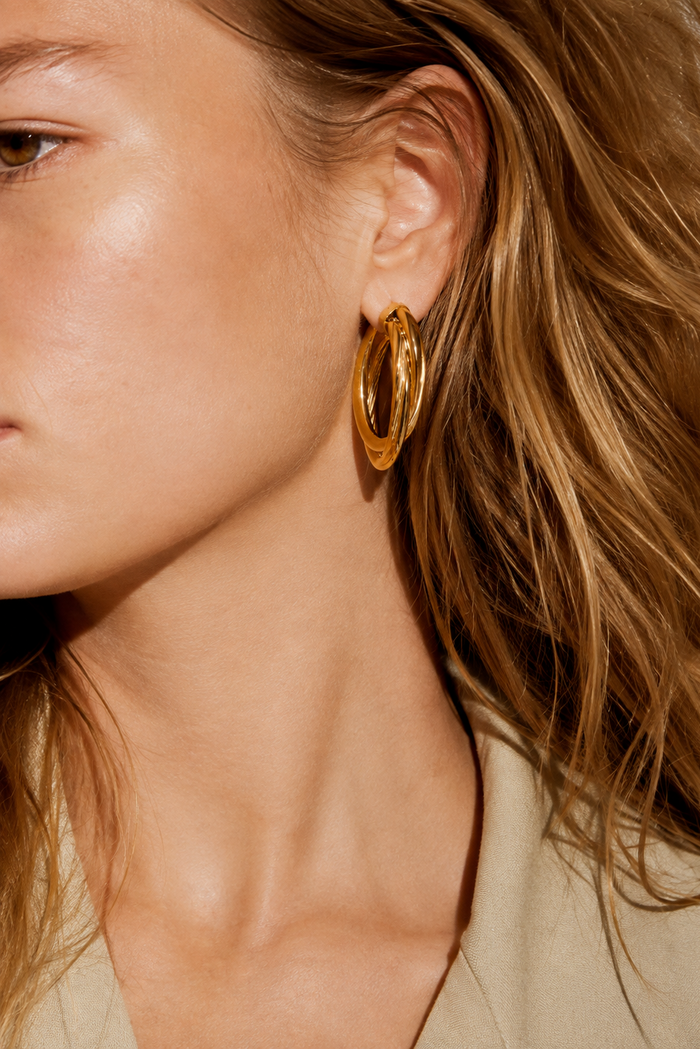
Twists, ridges and sculptural surfaces change how light moves across the hoop and make the profile more visible from different angles.

Huggies
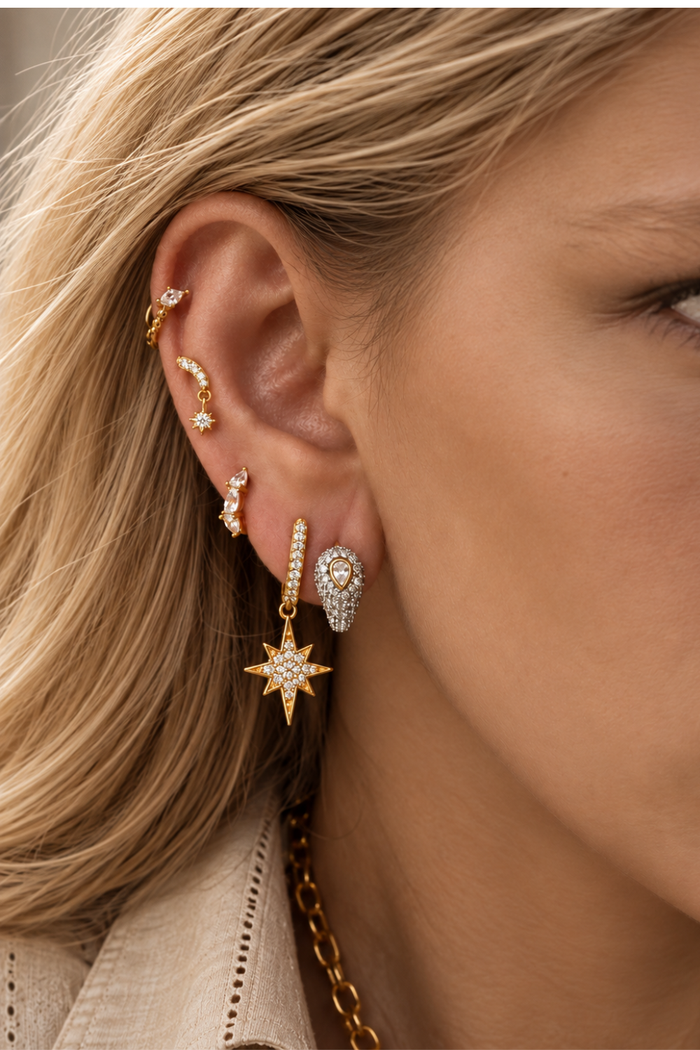
Compact hoops designed to sit close to the piercing — particularly useful when several earrings need to work together.

Drop & charm
A hoop or huggie with movement below it, whether the hanging detail is fixed or removable depending on the design.

Mixed metal
Gold and silver tones in one design, making them an easy bridge if you wear both metals elsewhere in your jewellery.
HUGGIE VS SMALL HOOP
Close fit or a little movement?
A huggie is a small hoop designed to sit closely around the lobe or piercing; a small classic hoop usually leaves more visible space and movement. Both can have a small diameter, but the intended fit is different.
A “10 mm hoop” does not tell you everything unless you also know whether the measurement is inner or outer diameter, how thick the body is and where your piercing sits.
Choose huggies when you want a close fit, a compact second-piercing option or a neat base for an ear stack. Choose a small classic hoop when you want a little more swing and a clearer circular outline.
HOOP VS DROP
Circle or vertical movement?
Gold hoops emphasise the circular silhouette around the ear; gold drop earrings add vertical movement below the lobe. Some designs sit between the two categories — for example, a huggie or U-lock earring with a hanging charm.
If the part you love is movement, a drop may actually suit your brief better than a larger hoop.
EXPLORE GOLD DROP EARRINGSEVERYDAY HOOPS
Can you wear gold hoop earrings every day?
Yes — provided the pair is comfortable for you, suitable for your ears and cared for according to its material and finish. For an everyday hoop, prioritise weight, a secure closure and a proportion that works with your routine.
Wear
“Everyday” does not have to mean tiny. A lightweight 3 cm or chunky hollow design may be perfectly comfortable for one wearer, while someone else may prefer a close huggie. Comfort is personal; specifications are more useful than assumptions.
Care
Plating is a surface finish. Contact with perfume, hairspray, creams, cleaning products, chlorine and prolonged moisture can shorten the life of that finish. Put earrings on after fragrance and beauty products have dried, store them dry and wipe them gently with a soft cloth after wear.
THE STYLING FORMULA
How do you style gold hoop earrings?
The easiest way to style gold hoops is to decide whether the hoop is the focal point or part of an ear story. From there, scale the rest of the jewellery up or down around it.

Let one hoop lead
Choose a sculptural or larger pair in the first piercing and keep the rest of the ear quiet. Particularly strong with puffy, twisted or textured profiles.

Build a graduated stack
Start with the largest hoop in the first piercing, then reduce the scale as you move up the ear. Add huggies, mini hoops, studs or an ear cuff.

Mix metals deliberately
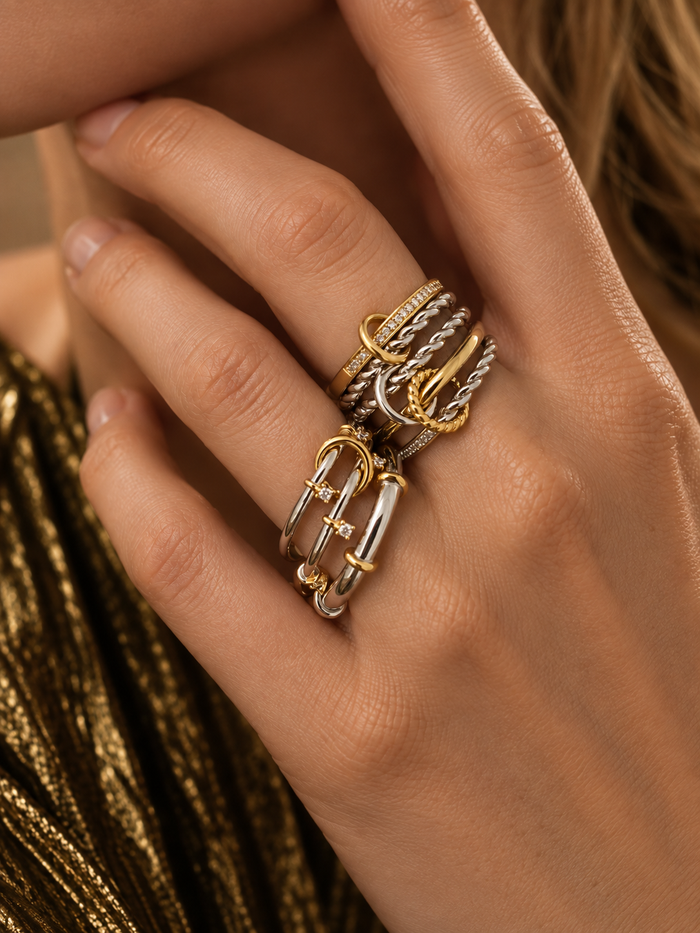
Repeat gold and silver at least twice so the combination reads as intentional. A mixed-metal piece can act as the bridge.

Add movement
If a stack feels too circular or uniform, introduce one drop element. A moving charm breaks the repetition without making the ear feel busy.
BEFORE YOU ADD TO BAG
What should you check before buying gold hoop earrings online?
Do not stop at the product photo. The most useful online listing gives you enough information to predict scale, comfort and fit before the earrings arrive.
- Diameter: ideally stated in millimetres or centimetres.
- Thickness: especially important for chunky, puffy and tubular hoops.
- Weight: where provided, more useful than guessing from appearance.
- Body material: sterling silver, brass, solid gold or another base.
- Post or wire material: the part that actually passes through the piercing.
- Finish: including the type of gold-plated finish where relevant.
- Closure: hinged, post-and-back or another mechanism depending on the design.
- Single or pair: especially important for piercing and stacking styles.
- On-ear photography: useful for judging proportion, while remembering every ear is different.
- Side-view photography: often the quickest way to understand true thickness and profile.
If a product looks dramatically different from the front and side, that is not a minor detail — it is part of the design. This is why we recommend judging hoops in three dimensions rather than from a single flat image.
ASKED & ANSWERED
Gold hoop earrings FAQ
What is the best gold hoop size for everyday wear?
For many people, around 20–30 mm (2–3 cm) is a versatile everyday range. Choose closer-fitting huggies if you want less movement, or go larger if you prefer a stronger silhouette. Thickness and weight matter just as much as diameter.
Are 2 cm or 3 cm gold hoops better?
Neither is universally better. A 2 cm hoop is more compact; a 3 cm hoop creates more movement and presence. If both are chunky, compare body thickness and weight before deciding. If both are slim, the 3 cm pair will usually read as the more noticeable silhouette.
What counts as a huggie earring?
A huggie is a small hoop intended to sit close to the lobe or piercing. The exact diameter that creates a “hugging” fit varies with both the earring design and your anatomy.
Are chunky gold hoops comfortable?
They can be. Chunky refers to appearance, not a guaranteed weight. Hollow and tubular construction can reduce the amount of material needed to create volume, but always check the actual product details if weight is important to you.
What should sensitive ears look for in gold hoops?
Check the post or wire material first, then the base metal and finish. Galleria Armadoro’s current hoop range uses 925 sterling-silver posts and REACH-compliant materials and is designed with sensitive ears in mind. Anyone with a diagnosed metal allergy should check the exact product specification before wear.
Are gold hoop earrings still in style?
Yes. Gold hoops are better treated as a permanent jewellery silhouette than as a seasonal trend. What changes is the proportion: one season may favour slim oversized hoops, another sculptural puffy forms, mixed metals or smaller huggies. The circle itself does not need a comeback.
Do gold hoops suit every face shape?
Face-shape rules are a useful styling suggestion, not a law. Diameter, thickness, hairstyle, neckline and the effect you want all matter more than trying to match your face to a fixed chart. If you like the proportion when you see it on your ear, that is the more useful test.
Can you mix gold and silver hoop earrings?
Absolutely. A simple way to make mixed metals feel intentional is to repeat each tone somewhere else in the ear or your wider jewellery stack. Two-tone hoops can also act as the bridge between both finishes.
How do you care for gold-plated hoop earrings?
Keep them dry when you are not wearing them, avoid direct contact with perfume, hairspray, creams, household cleaning products and chlorine, and wipe them gently with a soft cloth after wear. Store pieces separately where possible to reduce scratching and friction.
THE GALLERIA ARMADORO WAY
Choose the silhouette first. Then read the specifications.
Diameter decides the scale. Thickness decides the visual volume. Construction and weight decide how that volume feels. Material and closure decide how the earring interacts with your ear.
HOOP & HUGGIE FAQ
How do I know my hoop or huggie is securely closed?
Close the earring until the post is fully seated in the clasp. With a hinged huggie, you should usually feel or hear a small click. Give it a very gentle tug before wearing; it should stay closed without forcing. If the fastening feels loose or will not click into place, do not keep bending the post — contact us and send a photo so we can help.


